
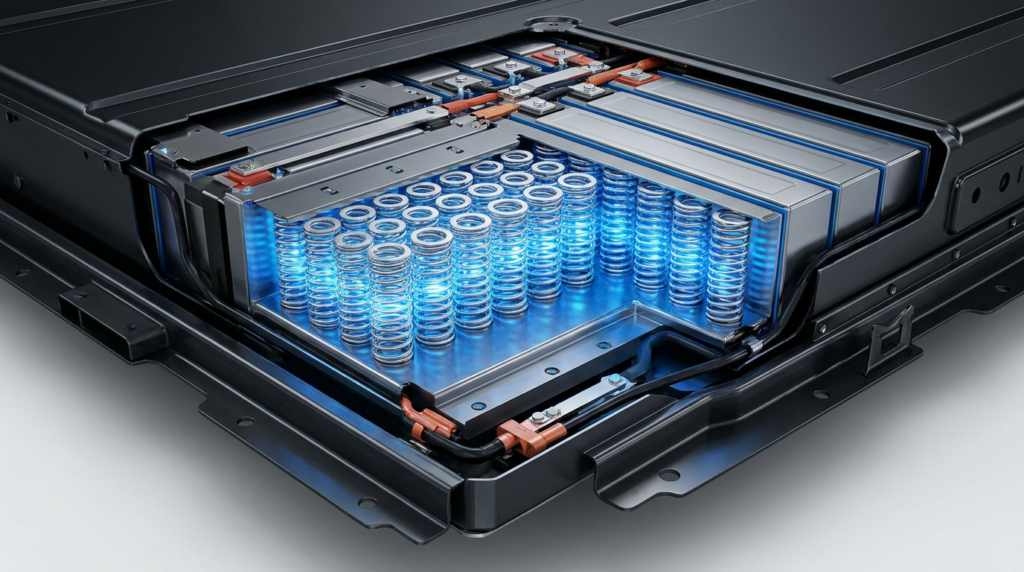
As the global automotive industry accelerates its transition toward full electrification, the year 2026 marks a pivotal shift in battery architecture. With the implementation of high-energy-density cells and rapid-charging protocols, the internal environment of a Power Battery System (PBS) has become more demanding than ever. While software-driven Battery Management Systems (BMS) get the headlines, the mechanical reliability of the system often rests on a silent hero: the precision spring.
The Critical Role of Springs in Modern EV Architecture
In 2026, the focus has shifted from simple energy storage to long-term structural integrity. Springs are no longer just hardware; they are functional components that manage thermal expansion, ensure electrical continuity, and provide vibration damping.
1. Compression Springs in Battery Module Clamping
Battery cells, particularly pouch and prismatic types, undergo significant volume changes during charge and discharge cycles.
- The Function: Custom compression springs for EV modules provide a constant “breathing” pressure. This prevents the delamination of internal cell layers, which is a leading cause of capacity fade.
- The Technical Edge: By utilizing high-fatigue-resistant alloys, these springs maintain consistent pressure over a 10-to-15-year vehicle lifespan, even under extreme temperature fluctuations.
2. Battery Contact Springs and BMS Connectivity
The Battery Management System (BMS) requires real-time data to prevent thermal runaway.
- The Function: BMS contact springs and battery contact springs ensure a low-resistance path for voltage sensing and temperature monitoring.
- The Reliability Factor: In a high-vibration environment (EV chassis), traditional soldered joints can fail. Precision-engineered springs offer a “compliant” connection that maintains contact through mechanical shocks, ensuring the BMS never loses sight of cell health.
3. Springs in Advanced Thermal Management Systems
Efficient cooling is the gatekeeper of EV range and safety.
- The Function: Thermal management springs are utilized in coolant valves and heat exchanger assemblies. They regulate the flow of dielectric fluids or refrigerants.
- Material Science: In 2026, the use of high temperature resistant springs (often made from Inconel or specialized stainless steels) is mandatory to withstand the corrosive nature of modern coolants and the heat generated during Level 3 fast charging.
Why Engineering Reliability Matters: The 2026 Landscape
The surge in new energy vehicle components demand is driven by more than just market growth; it is driven by regulation and safety standards. Following the logic of the U.S. Inflation Reduction Act (IRA) and the EU’s Battery Regulation, manufacturers are under immense pressure to source components that are both high-performing and sustainably produced.
As battery safety incidents continue to make headlines, the industry is moving toward a “Zero-Failure” mechanical philosophy. A single failed spring in a battery pack can lead to a localized hot spot, potentially triggering a thermal runaway event. Therefore, selecting a partner capable of custom spring manufacturing with rigorous precision machining is not just a procurement choice—它 is a safety imperative.
Conclusion: The Backbone of the Green Revolution
From ensuring the stability of a compression spring for EV modules to the millisecond responsiveness of a BMS sensor contact, springs are the mechanical glue holding the future of mobility together. For engineers and procurement specialists, the goal for 2026 is clear: optimize the small components to protect the large investments.
[References ]
- Journal of Power Sources (2025): “Mechanical Constraints and Their Impact on the Cycle Life of Prismatic Lithium-Ion Cells.” (Discussing the necessity of calibrated compression force in battery longevity).
- International Journal of Automotive Engineering: “Thermal Management Challenges in High-Nickel Battery Architectures for 2026 EV Models.”
- Spring Manufacturers Institute (SMI): “Technical Standards for High-Performance Alloys in Electric Vehicle Applications,” 2024 Edition.
- SAE International: “Vibration Resistance in BMS Interconnects: A Comparative Study of Compliant Pin vs. Spring Contact Technology.”