
Introduction: The New Era of Aerospace Expansion
Aerospace technology is currently entering a phase of rapid expansion. This growth is driven by deep-space exploration and high-altitude commercial flights. Consequently, the mechanical demands on every individual component have reached their physical limits. Among these parts, precision springs remain critical. Whether in satellite mechanisms or engine valves, these components must function flawlessly. However, they often face conditions that would disintegrate standard industrial hardware.
Material Science: The Backbone of Reliability
In the vacuum of space, traditional carbon steel quickly fails. Therefore, modern aerospace engineering relies heavily on superalloys to maintain structural integrity.
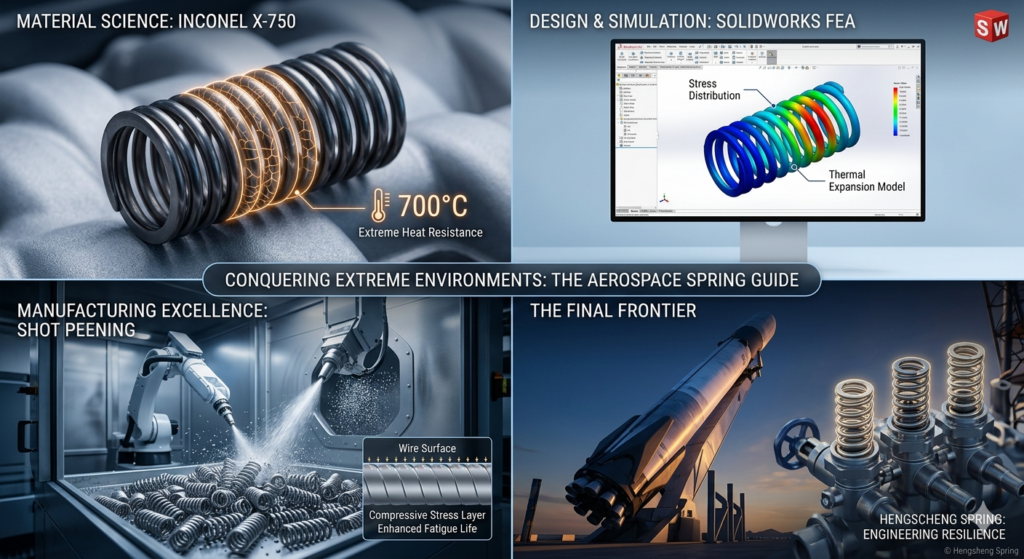
- Nickel-Based Alloys (e.g., Inconel 718/X-750): These are the gold standard for extreme heat. They exhibit exceptional strength at temperatures up to 700°C.
- Cobalt-Chrome & Titanium Alloys: Engineers choose these materials when weight reduction is vital. Furthermore, they offer essential non-magnetic properties.
- Corrosion Resistance: High-altitude environments involve moisture and jet fuel. As a result, stress corrosion cracking is a constant risk. Advanced materials ensure that the spring rate remains constant. In addition, they prevent oxidative degradation over thousands of cycles.
Design & Simulation: Engineering Certainty with SolidWorks (SW)
In the aerospace sector, failure is never an option. For this reason, digital twin technology and advanced simulation have become indispensable tools.
Using SolidWorks (SW) allows engineers to visualize complex spring geometries easily. Moreover, the real value lies in Finite Element Analysis (FEA):
- Stress Distribution: We identify potential fatigue points early. Specifically, this happens before a single coil is wound.
- Thermal Expansion Modeling: We simulate how dimensions change in extreme heat. For instance, a spring may move from -150°C to +200°C in minutes.
- Dynamic Load Testing: We ensure the parts withstand violent vibrations. Consequently, the springs maintain structural memory even during rocket launches.
Manufacturing Excellence: Strict Quality Control & Fatigue Testing
Producing an aerospace-grade spring requires extreme precision. Specifically, the standards are much higher than commercial requirements. At Hengsheng Spring, we emphasize a strict, closed-loop process:
- CNC Precision Winding: We use multi-axis CNC machines. As a result, we keep tolerances within microns.
- Shot Peening: This process introduces compressive stress on the surface. By doing so, we prevent crack initiation and enhance fatigue life.
- Rigorous Testing: Every batch undergoes intense cycle testing. In fact, we mimic years of operational wear in just a few days.
- Traceability: We maintain a digital paper trail for every part. Ultimately, this ensures compliance with ISO 9100 standards.
Conclusion: Navigating the Future of Advanced Mobility
The future of aerospace will demand lighter and stronger components. Clearly, this includes the rise of Urban Air Mobility (UAM) and reusable rockets. In conclusion, the synergy between spring engineering and material science remains the cornerstone of flight safety.
At Hengsheng Spring, we do more than manufacture parts. Instead, we engineer the resilience required to conquer the final frontier.