
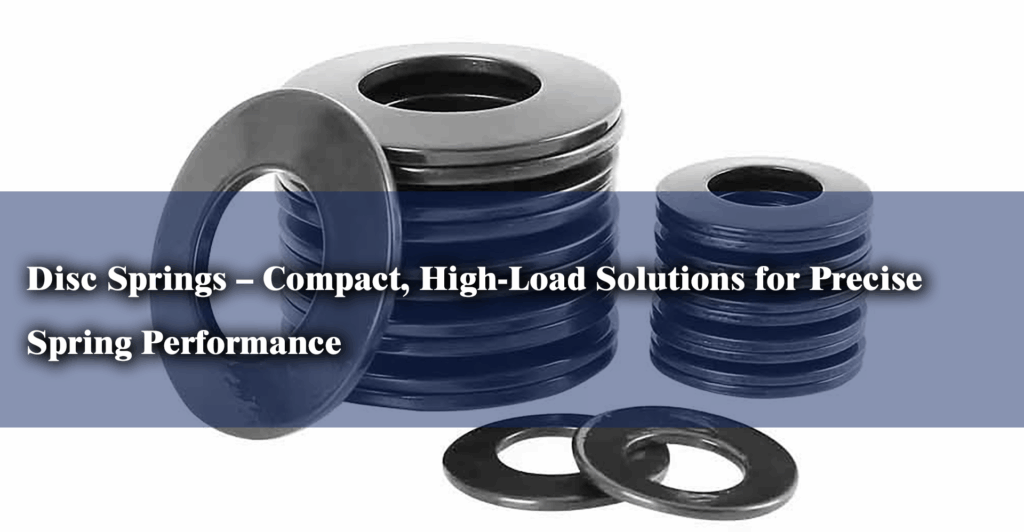
When engineers face tight spaces and heavy loads, disc springs—also known as Belleville springs—offer a compact and powerful solution. Their conical, washer-like shape allows them to generate significant force within minimal deflection. Moreover, you can stack them in series, parallel, or a combination to precisely tune load-deflection characteristics.
What Makes Disc Springs Unique?
Disc springs follow the well-established DIN EN 16984 standard, supporting predictable load-deflection behavior and fatigue life estimation. Therefore, they outperform coil springs in applications demanding compact strength, reliable performance, and long life
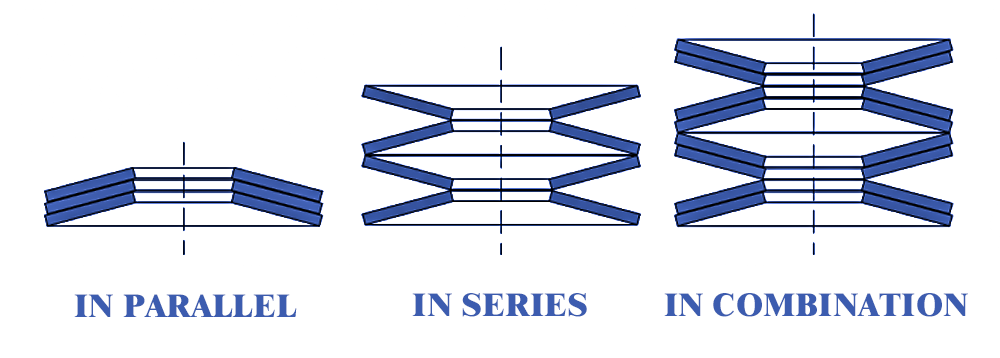
Stacking Configurations: Tailor Force and Deflection
You can configure stacks in several ways to balance force and movement:
-
Parallel Stacking: All discs face the same way. This multiplies load capacity while keeping deflection the same as for a single disc
-
Series Stacking: Alternate disc orientation. This achieves greater deflection without increasing required force
-
Combination (Series + Parallel): Enables both higher load and increased deflection—ideal for complex requirements
Friction, Hysteresis, and Practical Limits
Friction between discs in parallel stacks introduces hysteresis—actual load deviates from theoretical values. Typically, allow 2–3% friction per sliding surface. Lubricating interfaces with solid lubricants (e.g., molybdenum disulfide) helps minimize friction; usually, keep parallel stacks to 3–4 discs to avoid excessive deviation and heat build-up
Design Guidelines for Stack Stability
-
Prefer an even number of discs with outer edges at both ends for better stability. If an odd number is necessary, orient the outer edge toward the load-applied end
-
Keep stack height ≤ 3× the disc’s outer diameter or use up to 10 discs in series. Taller stacks may use intermediate washers to maintain stability
-
Guide the stack using a hardened mandrel or sleeve—surface-hardened to ≥ 58 HRC with ≤ 0.6 mm depth and surface finish ≤ 4 microns—for consistent alignment
Materials, Fatigue Life & Historical Roots
Disc springs are made from high-strength spring steel (e.g., 50CrV4) or stainless steel (e.g., 301, 17-7PH) to withstand load cycles and corrosion
Engineers estimate fatigue life using stress differences between preload and maximum load, referencing location-specific charts from DIN EN 16983
Interestingly, the design origin dates back to 1861—Julien Belleville patented the conical washer concept, laying the foundation for modern disc springs
Ideal Applications for Disc Springs
Thanks to their compact footprint and high force capability, disc springs excel in:
-
Clutches, brakes, and safety valves
-
Vibration damping, energy isolation, and load balancing in heavy machinery
-
Industrial pipe system supports and elevators
-
Applications where compact, reliable load control is essential
Your Next Step: Custom Disc Spring Solutions
Ready to improve performance and space efficiency? Thanks to their modular stacking flexibility, disc springs adapt precisely to your design needs.
Contact us now—we offer: OEM/ODM customization, precision engineering, and bulk supply for every industry requirement.