
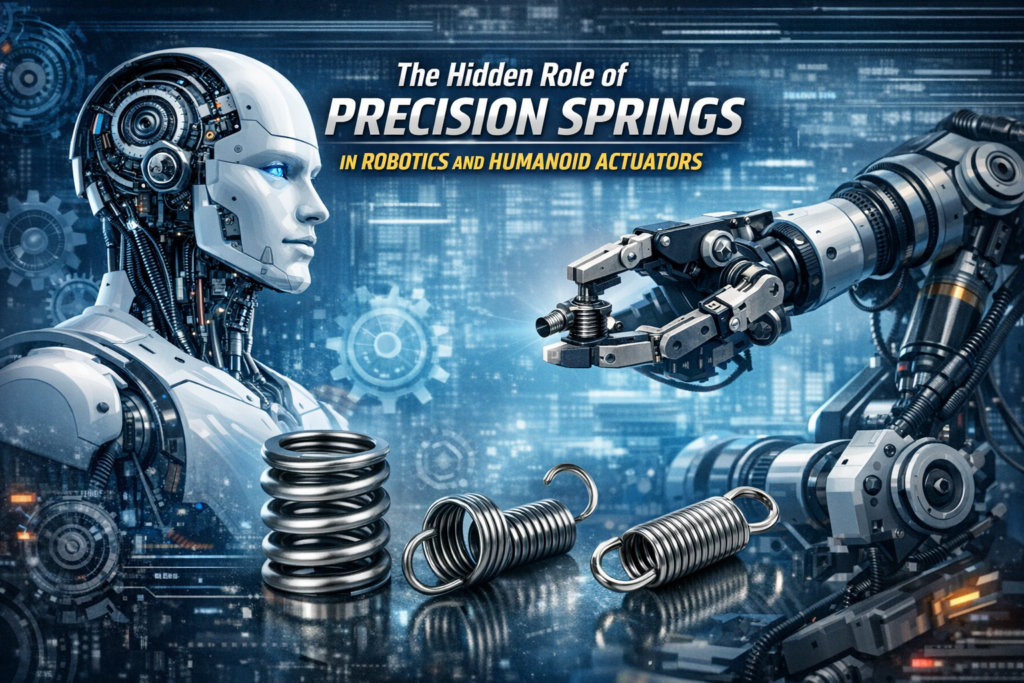
In the complex architecture of a humanoid robot, every movement requires a balance between strength and flexibility. Because of this, actuator spring design has become a decisive factor in overall performance.
1. Torsion Springs for Robot Joints: Driving Bio-inspired Movement
Humanoid joints require high torque density. To meet this need, engineers often integrate torsion springs for robot joints into rotary actuators.
- The Application: These springs provide essential gravity compensation. As a result, the motor consumes less power to hold a static position, which significantly extends battery life.
- Engineering Impact: High-quality springs mimic the elastic energy return of human tendons. Therefore, robots can walk or run with much higher energy efficiency than previous generations.
2. Force Control Springs: Ensuring Safe Human Interaction
Unlike traditional industrial robots, 2026-era humanoid robots must safely interact with humans. For this reason, designers embed force control springs within Series Elastic Actuators (SEA).
- The Application: These springs act as a mechanical buffer. In addition, they convert motor displacement into measurable force data.
- The Benefit: This mechanical setup enables “impedance control.” Consequently, the robot senses external resistance and reacts instantly, preventing accidental injury in smart factories.
3. Precision Springs in Grippers: Maintaining Delicate Control
The dexterity of a robotic hand depends on steady grip pressure. Similarly, miniature robotics springs provide the tension necessary for finger reset and tactile feedback systems. Moreover, manufacturers must produce these components with incredibly tight tolerances to ensure repeatable precision.
The Global Context: Why Demand is Surging
As labor costs rise globally, the shift toward “Lights-out Manufacturing” has accelerated. Furthermore, policies supporting automation have pushed humanoid robot components from experimental labs to mass production lines. In conclusion, the modern precision spring manufacturer no longer just winds wire; they solve complex material science challenges to support 24/7 autonomous operations.
[References / 参考文献]
- IEEE Transactions on Robotics (2025): “Design and Optimization of Series Elastic Actuators for Humanoid Locomotion.” (Similar foundational research)
- Science Robotics:“The Role of Elastic Elements in Bio-inspired Robot Design.”
- Journal of Mechanisms and Robotics:“High-Torque Density Joint Actuators: Integrating Torsion Springs for Gravity Compensation.”
- International Federation of Robotics (IFR) 2026 Report:“World Robotics Report: Service and Humanoid Robots Growth Trends.”
If you are developing robotic systems, choosing the right spring partner is essential.
At Hengsheng Spring, we provide:
- Custom precision springs
- Engineering support
- High-performance materials
Contact us today to develop spring solutions tailored to your robotic applications.