
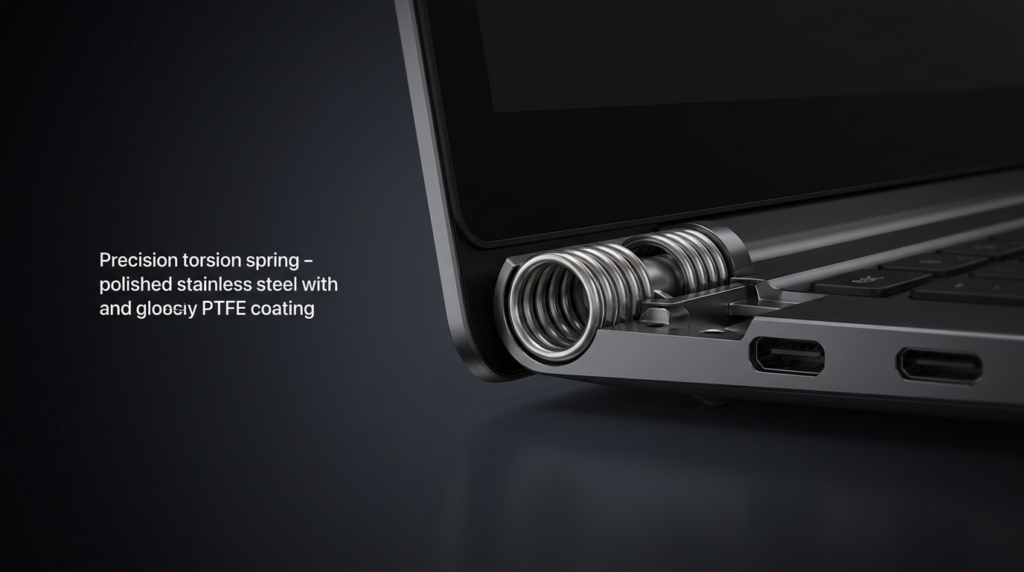
Discover how precision torsion springs create the “premium feel” in high-end devices. This analysis covers UX engineering, ±1% torque tolerance, and advanced surface coatings for 2026 consumer electronics.
1. User Experience Engineering: The Physics of “Premium”
In the realm of high-end electronics, “premium” is not a subjective feeling. Instead, engineers define it through a precisely calculated torque curve. Specifically, three mechanical parameters dictate how a user perceives quality.
- Torque Linearity: High-end foldable hinges or laptop screens require a specific Torque vs. Angle profile. Users often perceive a sudden drop in resistance as “flimsy.” In contrast, a perfectly linear or slightly progressive curve creates a sense of “substantial” quality.
- Angular Stiffness (K0): This parameter defines the “crispness” of a physical interface. High angular stiffness eliminates the “mushy” sensation in buttons or rotary dials.
- Hysteresis Management: Engineers must minimize the torque difference between loading (opening) and unloading (closing). Consequently, the device avoids a “stuck” feeling and ensures a smooth, consistent return.
For instance, premium camera manufacturers utilize a torsion spring-loaded ball to create a tactile “detent” in mode dials. The spring rate directly determines if the click sounds “metallic and expensive” rather than “plastic and cheap.”
2. Micro Precision Manufacturing: Scaling Below 0.1mm
When the wire diameter drops below 0.1mm, traditional physics takes a backseat to material sensitivity. As a result, producing these ultra-fine components introduces significant technical hurdles.
- The Challenge of Elastic Recovery: At this micro-scale, “spring back” after coiling becomes highly volatile. Therefore, a one-degree variation in the winding mandrel can cause a 5% torque error.
- Surface Integrity: Microscopic scratches on the wire act as stress concentrators. Consequently, these flaws lead to premature fatigue failure in devices rated for over 100,000 cycles.
To overcome these issues, manufacturers utilize CNC High-Speed Coiling with laser-guided tension control. Furthermore, they employ Atmospheric Heat Treatment in vacuum furnaces to prevent oxidation, ensuring the integrity of the ultra-fine wire.
3. Consistency & Quality Control: The ±1% Tolerance Frontier
Achieving a ±1% force tolerance in mass production represents the “Holy Grail” of spring manufacturing. To reach this goal, leading firms have moved beyond manual testing.
- Statistical Process Control (SPC): Advanced sorting systems now test every spring as it leaves the CNC line. Subsequently, the system bins the springs into “Tolerance Groups.” Only the “Golden Samples” at the center of the bell curve reach Tier-1 OEMs.
- Vision-Based Inspection: High-speed cameras with sub-micron resolution inspect the pitch and leg angle of every unit. Because even a 0.5° variation in a leg angle ruins the assembly preload, these automated systems are essential for maintaining a consistent user experience across 100,000+ units.
4. Surface Engineering: Aesthetics Meets Durability
For visible components, the finish is as critical as the mechanical function. However, different coatings serve different engineering purposes.
| Process | Durability | Corrosion Resistance | Visual Appearance | Primary Use Case |
| Electrophoresis (E-Coating) | High | Excellent | Uniform Matte/Gloss | Internal structural parts |
| Electroplating (Gold/Nickel) | Moderate | High | Premium Metallic | Visible contacts or hinges |
| PTFE (Teflon) Coating | High | Superior | Industrial/Functional | Low-friction moving joints |
In addition to aesthetics, designers often choose PTFE coating for its acoustic damping properties. By doing so, they eliminate the “squeak” or “scratch” sounds that could otherwise compromise the auditory quality of high-end audio gear.
5. Commercial Insight: Why Precision Springs are High-Value
Why would a brand pay a 500% premium for a “hidden” spring? The answer lies in the cost of failure.
- The Single Point of Perception: The spring serves as the primary interface between the user and the machine. If a hinge feels weak, the user perceives the entire $2,000 device as “cheap.” Therefore, the “Cost of Poor Quality” (COPQ) far outweighs the component’s unit price.
- B2B Requirements: Modern OEM/ODM buyers prioritize Stress Relaxation data and Tangle-free Packaging. Moreover, they demand compliance with global sustainability standards like REACH/RoHS.
In conclusion, a custom torsion spring is a calibrated instrument of haptic branding. By mastering micro-tolerances and the physics of the torque curve, manufacturers transition from being simple vendors to becoming essential UX partners.
[References ]
- Journal of Mechanical Design (2025): “Optimization of Micro-Torsion Springs for Haptic Feedback in Wearable Devices.”
- Materials Science & Engineering: “Fatigue Life Analysis of Ultra-Fine Alloy Wires in High-Cycle Consumer Electronics.”
- International Journal of Precision Engineering: “Automated Inspection Systems for High-Volume Spring Production.”
- Surface and Coatings Technology: “The Acoustic and Friction Impact of PTFE Coatings on Micro-Mechanical Assemblies.”