
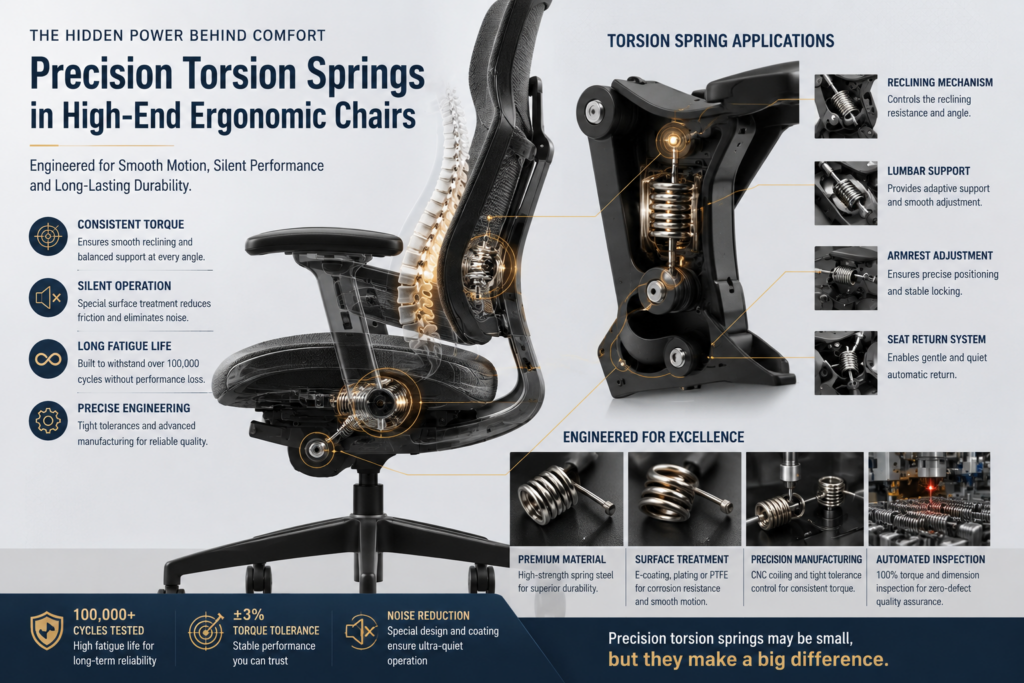
In 2026, the conversation around office furniture has shifted dramatically. Ergonomic chairs are no longer marketed solely as premium office accessories—they are increasingly positioned as long-term health investments. As remote work, hybrid offices, gaming setups, and wellness-focused workspaces continue to grow, users are paying closer attention to comfort, posture support, silent operation, and durability.
Behind many of these “premium feel” features lies an often-overlooked component: the precision torsion spring.
From synchronized reclining systems to lumbar support mechanisms, torsion springs quietly determine how an ergonomic chair moves, responds, and ages over time. For manufacturers, the quality of these springs directly affects user experience, product lifespan, and brand perception.
The Hidden Mechanical Core of Ergonomic Chairs
Most consumers evaluate a chair emotionally:
- Does the recline feel smooth?
- Is the resistance natural?
- Does the chair return quietly?
- Does it maintain support after years of use?
Mechanically, these sensations are controlled by torque consistency and motion damping—areas where torsion springs play a critical role.
Unlike standard compression springs, torsion springs are designed to store and release rotational energy. In ergonomic chairs, they are commonly integrated into:
- Reclining tilt systems
- Armrest adjustment modules
- Lumbar support structures
- Headrest positioning systems
- Seat return mechanisms
A poorly engineered torsion spring creates:
- Uneven resistance
- Excessive noise
- Sudden rebound
- Mechanical fatigue
- User discomfort
A high-precision torsion spring creates:
- Controlled movement
- Smooth tactile feedback
- Stable torque output
- Quiet operation
- Long-term reliability
This difference is often what separates a low-cost office chair from a premium ergonomic product.
Why “Premium Feel” Is Actually Mechanical Engineering
Consumers often describe premium ergonomic chairs using words like:
- Smooth
- Responsive
- Balanced
- Silent
- Supportive
These are not subjective accidents—they are measurable engineering outcomes.
Torque Consistency
In a reclining mechanism, torque consistency determines whether the chair provides uniform resistance throughout the reclining angle.
If the spring torque fluctuates excessively:
- The chair may feel loose at one angle
- Too stiff at another
- Or unstable during movement
High-end chair manufacturers often require:
- Torque tolerance within ±3%
- Stable angular response
- Repeatable motion over hundreds of thousands of cycles
Achieving this requires:
- Precision CNC coiling
- Strict heat treatment control
- Accurate wire forming geometry
- Automated torque testing
Fatigue Life: The Real Test of Quality
An ergonomic chair may experience thousands of movement cycles every month.
Over several years, that number can exceed:
- 300,000 cycles
- 500,000 cycles
- Or even 1 million motion cycles in commercial environments
This creates a major engineering challenge:
How can a torsion spring maintain consistent performance after years of repeated stress?
Material Selection Matters
Premium ergonomic chair springs are commonly manufactured using:
- Music wire
- Stainless steel
- Chrome silicon alloy steel
- Oil-tempered spring steel
Each material offers different advantages in:
- Fatigue resistance
- Corrosion resistance
- Torque stability
- Environmental durability
For example:
- Chrome silicon steel provides excellent fatigue performance under high cyclic loads
- Stainless steel improves corrosion resistance in humid environments
- Music wire delivers high strength for compact spring structures
Material selection directly impacts product lifespan and warranty costs.
Silent Operation: A Growing Consumer Expectation
Noise reduction has become one of the biggest trends in premium furniture engineering.
Users increasingly expect:
- Silent reclining
- Quiet adjustment
- Smooth return motion
- No metallic friction sounds
Even minor squeaking can significantly reduce perceived product quality.
How Springs Affect Chair Noise
Noise can originate from:
- Spring surface friction
- Poor coating adhesion
- Improper stress release
- Inconsistent spring geometry
- Metal-to-metal contact
To reduce operational noise, manufacturers often apply:
Electrophoretic Coating (E-coating)
Provides:
- Corrosion resistance
- Uniform surface coverage
- Improved aesthetics
PTFE (Teflon) Coating
Provides:
- Reduced friction
- Lower noise generation
- Smoother motion feel
Powder Coating or Electroplating
Enhances:
- Wear resistance
- Surface durability
- Visual appearance
The challenge is balancing:
- Mechanical performance
- Coating adhesion
- Long-term durability
- Production cost
Compact Mechanisms Require Advanced Spring Engineering
Modern ergonomic chairs are becoming increasingly sophisticated while also aiming for slimmer, more minimalist designs.
This creates a contradiction:
More mechanical functionality must fit into smaller spaces.
As a result, torsion springs must achieve:
- Higher torque density
- Smaller installation space
- More precise angular performance
Custom spring manufacturers are now required to optimize:
- Leg geometry
- Coil diameter
- Number of active coils
- Wire diameter
- Mounting orientation
Even minor deviations can affect:
- Recline smoothness
- Synchronization
- User comfort
- Structural safety
This is why many high-end furniture brands increasingly rely on custom spring suppliers instead of off-the-shelf components.
The Rise of Smart Ergonomic Furniture
Another emerging trend in 2026 is smart ergonomic seating.
Advanced office chairs are beginning to integrate:
- Weight sensing
- Adaptive lumbar systems
- Smart recline control
- Motion tracking
- AI-assisted posture adjustment
These systems require even more precise mechanical response.
Future spring systems may need to work alongside:
- Electric actuators
- Sensor systems
- Smart damping modules
This opens new opportunities for:
- Precision torsion springs
- Hybrid spring assemblies
- Micro-adjustment spring systems
The ergonomic chair industry is gradually becoming a high-precision mechanical engineering sector rather than simply a furniture market.
Why Custom Spring Manufacturing Matters
For ergonomic chair manufacturers, torsion springs are not commodity parts.
They directly influence:
- User comfort
- Product reputation
- Warranty performance
- Mechanical lifespan
- Brand positioning
This is why leading manufacturers increasingly demand:
- Custom torque curves
- Tight dimensional tolerances
- High-cycle fatigue testing
- Surface engineering solutions
- Automated quality inspection
A precision spring supplier is no longer just a component vendor—it becomes part of the product engineering process.