
As Electronic Systems Become More Powerful, EMI Protection Becomes More Critical
Modern electronic devices are becoming smaller, faster, and more powerful than ever before.
From AI servers and autonomous vehicles to medical imaging equipment and aerospace communication systems, today’s technologies rely on high-speed data transmission and dense electronic packaging.
However, these advances create a growing challenge:
Electromagnetic Interference (EMI).
Uncontrolled EMI can lead to:
- Signal degradation
- Data transmission errors
- Equipment malfunction
- Reduced system reliability
- Regulatory compliance failures
As a result, engineers are increasingly seeking more effective EMI shielding solutions.
While traditional fingerstock gaskets have been widely used for decades, many manufacturers are now transitioning to canted coil spring technology to meet the demands of next-generation electronic systems.
Understanding EMI Shielding
EMI shielding is the process of preventing unwanted electromagnetic energy from entering or leaving an electronic enclosure.
To achieve effective shielding, a conductive path must be maintained between mating surfaces.
This conductive path allows electromagnetic energy to be safely redirected rather than interfering with sensitive electronics.
An effective shielding solution must provide:
- Consistent electrical conductivity
- Reliable contact pressure
- Long-term durability
- Resistance to vibration and wear
- Performance across varying tolerances
These requirements become increasingly challenging as devices become more compact and complex.
What Is Fingerstock?
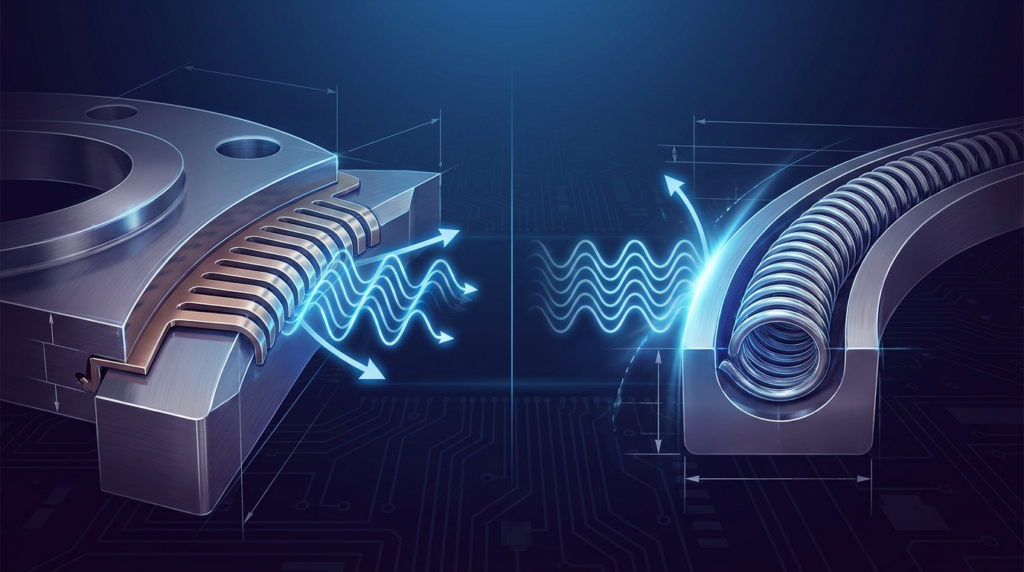
Fingerstock is a traditional EMI shielding solution Manufacturing manufactured from stamped metal strips with multiple spring-like fingers.
For many years, fingerstock has been used in:
- Telecommunications equipment
- Industrial control systems
- Military electronics
- Electronic enclosures
Its primary function is to maintain conductive contact between metal surfaces.
Although effective in many applications, fingerstock technology has several limitations when used in modern high-performance systems.
The Challenges of Traditional Fingerstock
As equipment becomes smaller and more demanding, engineers often encounter issues with conventional fingerstock designs.
Uneven Contact Pressure
Fingerstock relies on individual metal fingers to create contact.
Over time, some fingers may deform more than others, resulting in:
- Inconsistent shielding performance
- Reduced conductivity
- Localized wear
Permanent Set and Fatigue
Repeated compression can gradually reduce the elasticity of fingerstock.
This phenomenon, known as permanent set, causes:
- Lower contact force
- Reduced shielding effectiveness
- Increased maintenance requirements
In environments with frequent access or maintenance cycles, this can significantly shorten service life.
Limited Tolerance Compensation
Modern electronic assemblies often contain dimensional variations caused by:
- Manufacturing tolerances
- Thermal expansion
- Mechanical movement
Fingerstock may struggle to maintain reliable contact across large tolerance ranges.
Wear and Mechanical Damage
Repeated insertion and removal can cause:
- Finger deformation
- Surface wear
- Contact degradation
These issues become increasingly problematic in high-cycle applications.
What Makes Canted Coil Springs Different?
A canted coil spring is a precisely engineered spring consisting of individual coils positioned at a specific angle relative to the spring axis.
Unlike fingerstock, which depends on individual stamped fingers, canted coil springs create multiple independent contact points throughout the entire sealing interface.
This unique geometry provides several significant advantages.
Near-Constant Contact Force
One of the most important benefits of canted coil springs is their ability to maintain nearly constant force over a wide range of deflection.
This means the spring can accommodate:
- Manufacturing tolerances
- Surface irregularities
- Thermal expansion
- Mechanical movement
while maintaining consistent contact pressure.
For EMI shielding, this translates into more stable electrical continuity and improved shielding performance.
Superior Tolerance Compensation
As electronic systems become increasingly compact, dimensional variations become more difficult to control.
Canted coil springs can compensate for:
- Larger gap variations
- Misalignment
- Surface inconsistencies
without compromising electrical performance.
This capability is particularly valuable in:
- Aerospace systems
- Defense electronics
- Medical devices
- AI computing hardware
Enhanced Durability and Service Life
Unlike traditional fingerstock, canted coil springs distribute mechanical loads more evenly throughout the spring structure.
Benefits include:
- Reduced wear
- Lower stress concentration
- Improved fatigue resistance
- Longer operational lifespan
In applications requiring thousands of compression cycles, this can significantly improve reliability.
Improved EMI Shielding Performance
The multiple contact points created by a canted coil spring establish a highly conductive path between mating surfaces.
This results in:
- Lower contact resistance
- Better electrical continuity
- More effective EMI attenuation
- Consistent shielding performance over time
As operating frequencies continue to increase, maintaining reliable conductivity becomes increasingly important.
Applications Driving Adoption
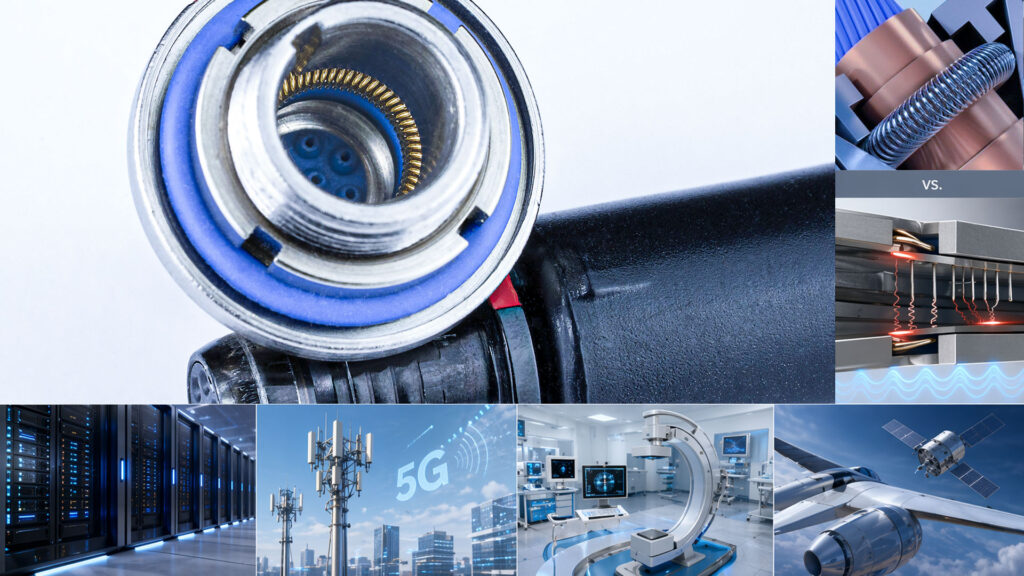
Several fast-growing industries are accelerating the adoption of canted coil spring shielding solutions.
AI Data Centers
High-speed processors generate substantial electromagnetic noise.
Reliable shielding helps maintain signal integrity throughout server systems.
Autonomous Vehicles
Advanced driver-assistance systems rely on numerous sensors and communication modules.
EMI protection is critical for safe operation.
Medical Equipment
MRI systems, patient monitoring devices, and implantable electronics require highly reliable electromagnetic compatibility.
Aerospace and Defense
Mission-critical systems demand shielding solutions capable of withstanding vibration, temperature changes, and harsh environments.
5G and High-Speed Communications
As communication frequencies increase, shielding effectiveness becomes even more important.
Canted coil springs help maintain stable performance in demanding RF environments.
The Future of EMI Shielding
The electronics industry is moving toward:
- Higher frequencies
- Greater power density
- Smaller device footprints
- Increased reliability requirements
These trends are exposing the limitations of traditional shielding technologies.
Engineers are increasingly selecting solutions that provide:
- Longer service life
- Better tolerance compensation
- Consistent electrical performance
- Lower maintenance requirements
Canted coil spring technology meets these requirements while offering superior mechanical and electrical characteristics.
As a result, it is rapidly becoming the preferred choice for next-generation EMI shielding applications.
Conclusion
For decades, fingerstock has served as a reliable EMI shielding solution.
However, the demands of modern electronics are changing.
As AI infrastructure, autonomous systems, medical devices, and advanced communication technologies continue to evolve, manufacturers require shielding solutions capable of delivering higher performance and longer service life.
With near-constant force, multiple contact points, superior durability, and exceptional tolerance compensation, canted coil springs are emerging as a powerful alternative to traditional fingerstock.
For engineers designing the next generation of electronic systems, understanding these advantages can provide a significant competitive edge in achieving long-term reliability and electromagnetic compatibility. Please contact our engineering team for custom solutions.