
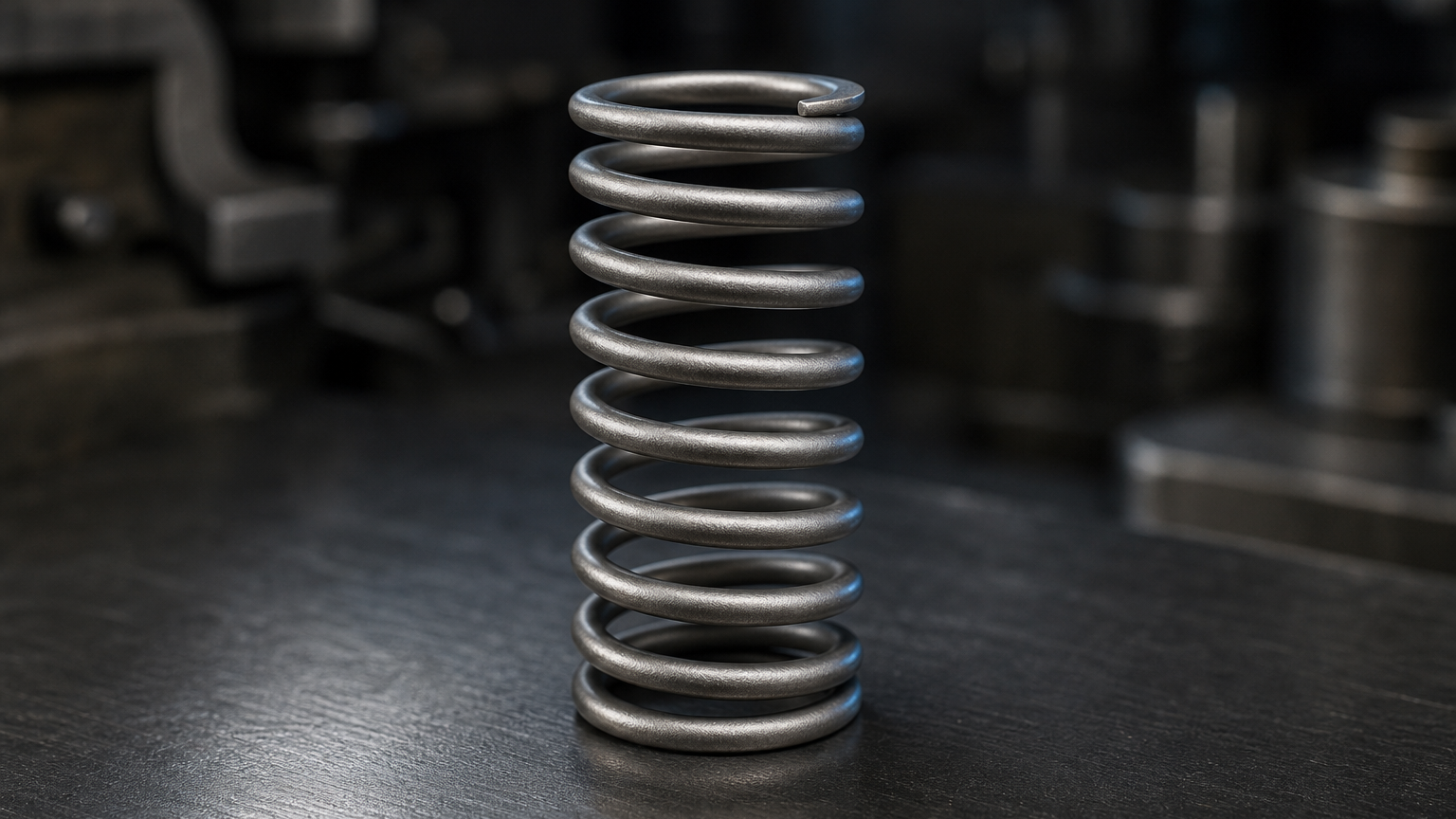
Most spring specifications are solved with stainless steel or, at the extreme end, a nickel-based superalloy such as Inconel 718. But there is a narrow and unforgiving band of operating conditions where every one of those materials fails — and where a tantalum-tungsten (Ta-W) alloy spring becomes the only option that survives.
This guide answers three questions that design engineers and procurement teams ask before specifying a refractory metal spring:
- Under what conditions should you actually use a tantalum-tungsten spring?
- How does it differ from a conventional spring material?
- Why does it cost what it costs — and what is the market rationale behind that price?
Every figure below is attributed to a traceable source: international standards, U.S. Geological Survey data, or published industry technical literature. Where a value originates from a supplier datasheet rather than a standard, it is explicitly labelled as such.
1. What Is a Tantalum-Tungsten Alloy Spring?
A tantalum-tungsten spring is a wire-formed (coil) or strip-formed (flat/leaf) spring manufactured from a tantalum-based refractory alloy, most commonly Ta-10W (90% tantalum / 10% tungsten).
Because there is no dedicated international product standard for tantalum-tungsten springs, the correct way to specify one is to combine a material standard with general mechanical test standards:
| Category | Standard | What it governs |
|---|---|---|
| Material (wire) | ASTM B365 — Tantalum and Tantalum Alloy Rod and Wire | The primary specification for spring wire; defines grades R05200, R05400, R05255 (Ta-10W), R05252 (Ta-2.5W) and R05240 |
| Material (sheet/strip) | ASTM B708 — Tantalum and Tantalum Alloy Plate, Sheet, and Strip | Flat springs and leaf-type elements |
| Material (tube) | ASTM B521 — Tantalum and Tantalum Alloy Seamless and Welded Tubes | Reference only; not a primary spring form |
| Tension testing | ASTM E8 / E8M | Room-temperature tensile properties of the finished wire |
| Fatigue testing | ASTM E466 (force-controlled) / ASTM E606 (strain-controlled) | Axial fatigue characterisation |
1.1 The grades defined by ASTM B365
| UNS Grade | Composition | Melting route |
|---|---|---|
| R05200 | Unalloyed tantalum | Electron-beam or vacuum-arc melted |
| R05400 | Unalloyed tantalum | Powder-metallurgy consolidated |
| R05255 | Tantalum alloy, 90% Ta + 10% W (Ta-10W) | Electron-beam or vacuum-arc melted |
| R05252 | Tantalum alloy, 97.5% Ta + 2.5% W (Ta-2.5W) | Electron-beam or vacuum-arc melted |
| R05240 | Tantalum alloy, 60% Ta + 40% Nb | Electron-beam or vacuum-arc melted |
Important specification note: ASTM F560 — the surgical implant standard — covers unalloyed tantalum only (UNS R05200 and R05400). It does not apply to Ta-10W or any other tantalum-tungsten grade. A Ta-10W spring must never be described as “compliant with ASTM F560.”
1.2 Why tungsten is added at all
Pure tantalum is already extraordinarily corrosion-resistant, but it is relatively soft. Alloying with tungsten raises the room-temperature tensile strength and elastic modulus while preserving the corrosion behaviour that makes tantalum valuable in the first place. According to ASM International's Refractory Metal Alloys, Ta-10W provides a higher room-temperature tensile strength and a higher elastic modulus than unalloyed tantalum — with a minimum annealed tensile strength of 482 MPa (70 ksi) and an elastic modulus of 207 GPa.
For comparison, unalloyed tantalum in the annealed condition sits around 207 MPa UTS / 138 MPa yield / 185 GPa modulus, and Ta-2.5W around 276 MPa UTS / 207 MPa yield / 185 GPa (Titan Metal Fabricators / H.C. Starck technical data).
2. When Do You Actually Use a Tantalum-Tungsten Spring?
This is the single most important question in the entire material decision, and the answer is narrower than most suppliers admit. Ta-W is not a “better stainless steel.” It is a problem-solver for a specific set of failure modes.
There are five situations that justify the specification.
2.1 Hot, concentrated mineral acids — the strongest case
If a spring must operate inside hydrochloric, sulfuric, nitric or phosphoric acid at elevated temperature, the material shortlist collapses very quickly.
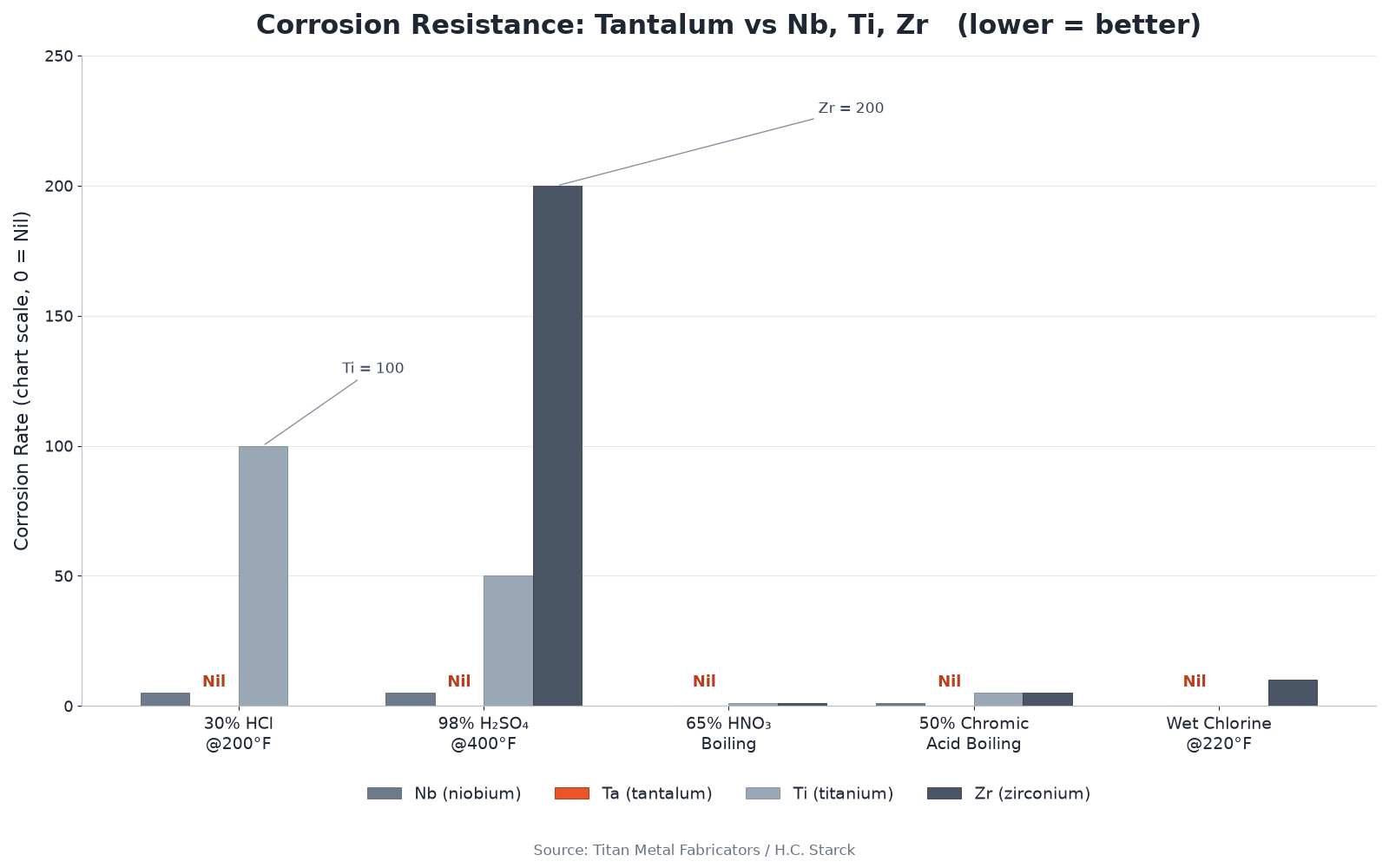
The most direct evidence is a corrosion comparison published by Titan Metal Fabricators / H.C. Starck, which benchmarks niobium (Nb), tantalum (Ta), titanium (Ti) and zirconium (Zr) across aggressive media. Values are given on the original chart’s scale, where “Nil” means no measurable corrosion:
| Medium | Concentration | Temperature | Nb | Ta | Ti | Zr |
|---|---|---|---|---|---|---|
| Hydrochloric acid (HCl) | 5% | 200°F (93°C) | 1 | Nil | 100 | Nil |
| Hydrochloric acid (HCl) | 30% | 200°F (93°C) | 5 | Nil | 100 | Nil |
| Sulfuric acid (H₂SO₄) | 40% | Boiling | Nil | Nil | 5 | 3 |
| Sulfuric acid (H₂SO₄) | 98% | 400°F (204°C) | 5 | Nil | 50 | 200 |
| Nitric acid (HNO₃) | 65% | Boiling | Nil | Nil | 1 | 1 |
| Nitric acid (HNO₃) | 99% | Boiling | Nil | Nil | 5 | 1 |
| Chromic acid | 50% | Boiling | 1 | Nil | >5 | 5 |
| Wet chlorine | Wet | 220°F (104°C) | Nil | Nil | Nil | 10 |
| Acetic acid | 50% | Boiling | Nil | Nil | Nil | Nil |
| Sodium hydroxide | 10% | Ambient | Nil1 | Nil1 | Nil | Nil |
1 The original chart notes that tantalum is not resistant to hydrofluoric acid or hot, strong alkalis.
The two rows that matter most for spring design are the ones where the alternatives collapse:
- 30% HCl at 200°F: titanium corrodes at a rate of 100 on the chart’s scale while tantalum is Nil.
- 98% H₂SO₄ at 400°F: zirconium reaches 200 while tantalum remains Nil.
Supporting qualitative conclusions from the same source:
- Tantalum is inert to sulfuric and hydrochloric acid at all concentrations below 300°F (149°C), shows no significant corrosion below 400°F (204°C), and has a general service ceiling around 500°F (260°C).
- Tantalum resists nitric acid at concentrations up to 98% at temperatures at or above 212°F (100°C).
- An IAEA technical document independently states that below 150°C, tantalum is inert to all concentrations of hydrochloric acid, nitric acid, 98% sulfuric acid and 85% phosphoric acid.
- Tantalum’s corrosion resistance is frequently described as “comparable to glass,” derived from its naturally forming surface oxide film.
Field evidence: some heat-exchanger installations using tantalum have operated continuously for more than 40 years without gasket replacement.
2.2 Applications where a spring failure stops the plant
The strongest direct evidence that tantalum-tungsten springs exist as a commercial product comes from published refractory-metal wire data: Ta-10W and Ta-7.5W wire is formed into Ta-10W and Ta-7.5W springs used as chlorinator springs (Fortu Tech, supplier-published technical data).
A chlorinator spring sits inside the chemical feed section of a chlorine dosing system — dripping-wet chlorine gas, hypochlorous acid, and chloride-rich brine. It is a spring that must not fail, in a location that cannot be easily serviced. That profile defines the commercial niche:
Strong corrosion + long unattended service + high cost of failure.
The same supplier literature lists adjacent applications for tantalum-tungsten wire: electrodes in high-salinity wastewater electrolysis systems, corrosion-resistant conductors for pH/ORP probes, and electrodes for on-line heavy-metal monitoring.
2.3 High-temperature service — but only with an atmosphere caveat
Tantalum-tungsten has genuine high-temperature capability. Supplier-published data indicates Ta-10W retains approximately 200–400 MPa tensile strength at 1000°C, and that its creep resistance is superior to unalloyed tantalum, making it suitable for long-duration high-temperature load bearing.
However, this capability is atmosphere-dependent and must never be quoted without qualification.
According to published engineering data, significant oxidation of tantalum begins at approximately 600°C. Above that threshold, a protective coating (for example, a silicide coating) is required. ASM International’s superalloy literature confirms the general rule for refractory metals: they retain mechanical properties to very high temperatures but have poor oxidation resistance.
| Service condition | Practical temperature capability |
|---|---|
| Vacuum or inert atmosphere | Long-term service above 1000°C is achievable |
| In air (uncoated) | Limited by oxidation onset at approximately 600°C |
| In air (with protective coating) | Extended by the coating system; verify application-specifically |
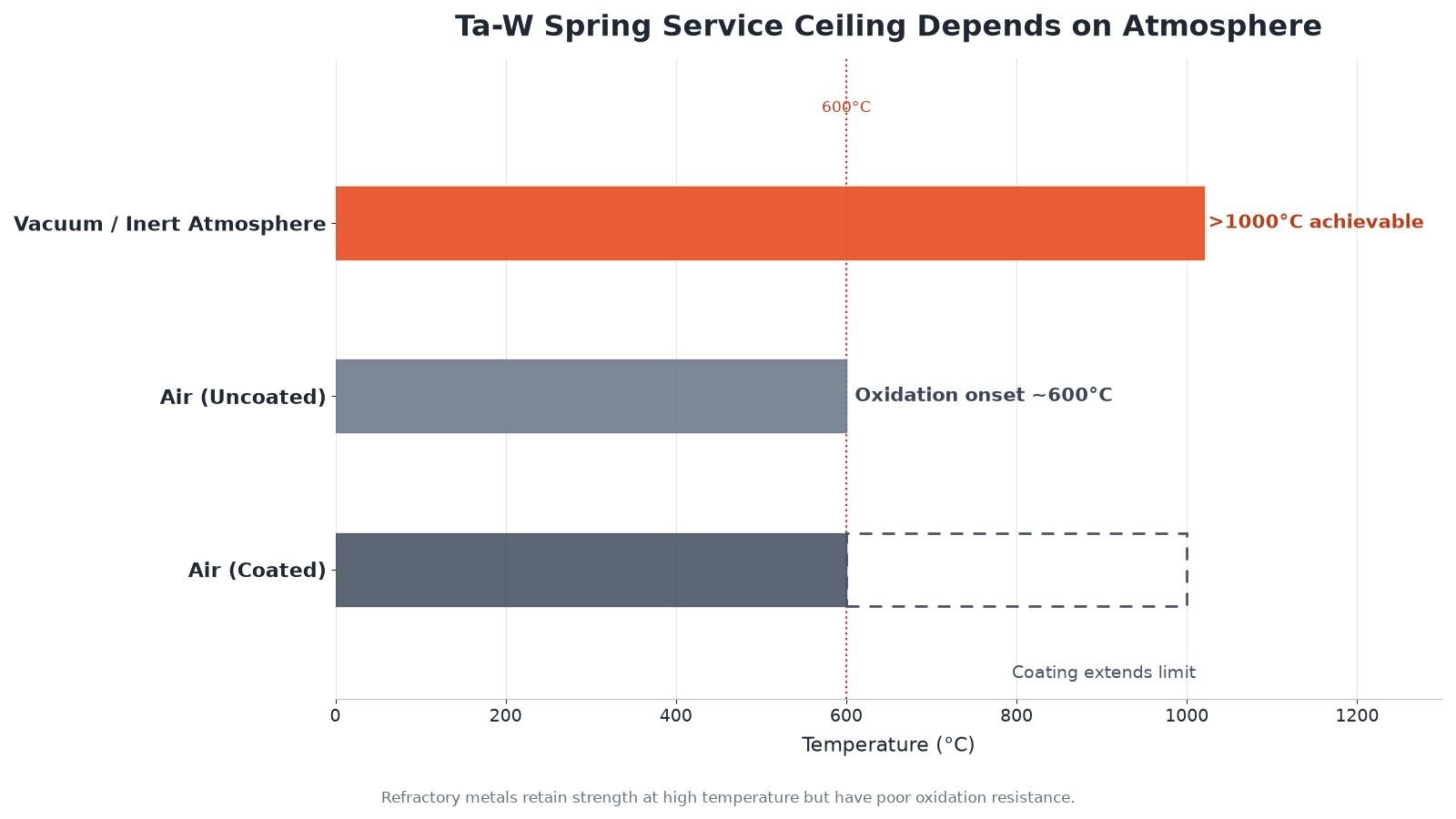
A tantalum-tungsten spring is not a “1000°C air spring.” Any specification claiming otherwise is technically incorrect.
2.4 Bio-compatibility and high-visibility medical use
Unalloyed tantalum has a long history in surgical implants, standardised under ASTM F560. Tantalum is also valued in medical device design for its high X-ray visibility.
Note the boundary: because ASTM F560 covers only unalloyed tantalum (R05200 / R05400), a Ta-W alloy spring cannot claim F560 compliance. For implantable or patient-contacting applications, grade selection must be made jointly with the device manufacturer and the applicable regulatory pathway — the material standard alone does not settle the question.
2.5 Nuclear and high-reliability instrumentation
Tantalum is used in neutron-absorbing and high-reliability instrumentation contexts, and its corrosion behaviour under reactor-coolant chemistry is documented in IAEA technical literature. For springs in instrumentation assemblies that must remain functional after years of exposure, the same “corrosion + non-failure” logic applies.
2.6 A note on what Ta-W is not for
Tantalum-tungsten is the wrong choice when:
- The service fluid contains hydrofluoric acid or fluoride ions — tantalum’s resistance drops sharply.
- The service fluid is fuming sulfuric acid containing free SO₃ or SO₂.
- The application involves hot, concentrated alkalis.
- The only driver is mechanical performance. Tantalum-tungsten’s elastic modulus (185–207 GPa) is the same order of magnitude as stainless steel (~193–200 GPa), so there is no stiffness advantage. Its density (16.6–17 g/cm³) is roughly twice that of steel, so it offers no lightweighting benefit and its specific stiffness is lower than steel’s.
- The budget cannot absorb a refractory-metal part. See Section 4.
The decisive design rule: tantalum-tungsten is not selected for stiffness — it is selected for survivability. If the environment is not actually hostile, Ta-W adds cost and mass without adding value.
3. How a Tantalum-Tungsten Spring Differs from a Conventional Spring
This is where most material-selection mistakes happen: engineers assume the refractory alloy wins on mechanical grounds. It does not. The difference is environmental, not mechanical.
3.1 Side-by-side material comparison
| Design dimension | Stainless steel (302 / 304) | Precipitation-hardening SS (17-7PH / 17-4PH) | Nickel superalloy (Inconel 718 / X-750) | Tantalum-tungsten (Ta-10W) |
|---|---|---|---|---|
| Max. continuous service temperature | approx. 550–650°F (288–343°C) ᴳ | 17-4PH H900 approx. 316°C continuous ᴳ | approx. 700°C (Inconel 718) ᴳ | >1000°C in vacuum / inert atmosphere ᴳ; in air, limited by oxidation at approx. 600°C |
| Resistance to HCl / H₂SO₄ | Dilute, ambient only; not suitable in hot concentrated acid | Similar to 302/304 | Good, but far below tantalum | Nil (no measurable corrosion) at 30% HCl @200°F and 98% H₂SO₄ @400°F |
| Elastic modulus | approx. 193–200 GPa | approx. 200 GPa | approx. 200 GPa | 185–207 GPa — same order of magnitude |
| Density | approx. 7.8–8.0 g/cm³ | approx. 7.8 g/cm³ | approx. 8.2 g/cm³ | 16.6–17 g/cm³ (approx. 2× steel) |
| Stress-relaxation resistance | Degrades significantly above moderate temperature | Better than plain stainless | X-750 is noted for relaxation resistance ᴳ | Creep resistance superior to unalloyed tantalum ᴳ |
| Cost logic | Low | Moderate | High | Very high (scarce feedstock + critical-mineral status) |
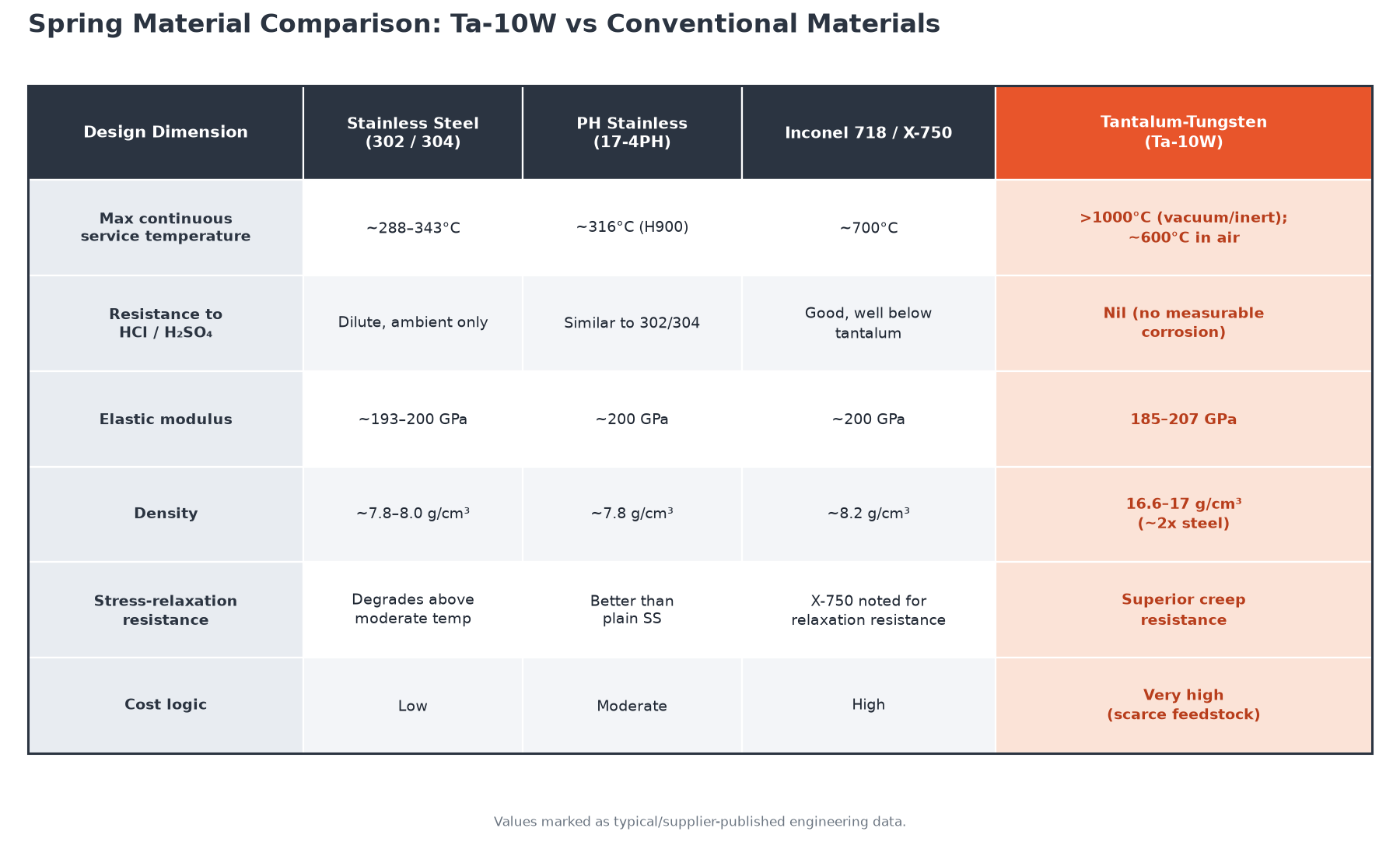
ᴳ = supplier-published / typical engineering data. Verify against the applicable ASTM or ASM handbook value before committing to a formal design release.
3.2 The three genuine differences
Difference 1 — Corrosion resistance is in a different class, not a different degree.
Stainless steel and Inconel resist corrosion up to a limit. Tantalum resists it absolutely within its valid envelope: “Nil” on a comparison chart against titanium’s 100 and zirconium’s 200 is a categorical difference, not an incremental improvement.
Difference 2 — High-temperature limits depend on atmosphere, not just temperature.
A stainless spring is characterised by a single temperature ceiling. A tantalum-tungsten spring’s ceiling is a function of temperature × atmosphere × coating. This makes the specification more complex, but it also unlocks service regimes that no conventional spring material can reach.
Difference 3 — The engineering economics are inverted.
For stainless steel, the decision is driven by unit price. For Ta-W, the decision is driven by life-cycle cost and downtime avoidance. A spring that costs orders of magnitude more per piece but prevents an unplanned shutdown of a chemical process line can be the far cheaper engineering decision. This is the correct framing for any internal cost justification.
3.3 What does not change
Designers coming from conventional spring work can carry over more than they expect:
- Stiffness design logic. Because the elastic modulus of Ta-10W (207 GPa per ASM) sits within the same band as stainless steel, spring-rate calculations and classical formulas can be applied with the corrected modulus value.
- Test methodology. Mechanical verification follows standard routes — ASTM E8 for tensile properties and ASTM E466 / E606 for fatigue. There is no need for exotic test infrastructure.
- Failure modes. Edge condition, surface finish and stress concentration matter exactly as they do in steel springs. Surface defects remain the dominant fatigue-initiation site — which is why edge and surface quality control is critical for refractory springs.
3.4 Data availability: what the industry does not publish
An honest material-selection guide has to state its limits:
- There is no dedicated international product standard for tantalum-tungsten springs (no ISO, ASTM, DIN, SAE or JIS spring-specific standard was identified).
- No public S-N (fatigue life) curve and no published stress-relaxation curve for tantalum-tungsten springs were identified in the public domain.
The practical consequence: fatigue life for a Ta-W spring must be established by application-specific testing under ASTM E466 or E606, not extrapolated from a handbook curve. Any supplier quoting a specific cycle count without a supporting test report should be asked for the data.
4. The Market Value of Tantalum-Tungsten
The price of a tantalum-tungsten spring is not an arbitrary markup. It is a direct consequence of feedstock scarcity, supply concentration and strategic-mineral policy for its two constituent metals.
4.1 Official price and supply data — Tantalum
Source: U.S. Geological Survey, Mineral Commodity Summaries 2025 — Tantalum (published January 2025).
| Indicator | Value |
|---|---|
| Tantalite average annual price | USD 170 / kg (contained Ta₂O₅, 2024; 2023: USD 170; 2022: USD 196) |
| U.S. apparent consumption (2024 est.) | 770 t — up 75% versus 2023 |
| U.S. imports / exports (2024 est.) | 1,300 t / 480 t |
| Value of 2024 U.S. tantalum consumption | Over USD 230 million (import value basis) |
| U.S. domestic mine production | Zero — no tantalum mining since 1959 |
| Net import reliance | 100% |
| Import sources (metal & powder, 2020–23) | China 43%, Germany 27%, Kazakhstan 15%, Thailand 5%, other 10% |
| Trade policy | September 2024: USTR imposed a 25% tariff on critical minerals including tantalum |
| Recycling | Recycled material may account for 30% of U.S. first-processor consumption |
4.2 Official price and supply data — Tungsten
Source: U.S. Geological Survey, Mineral Commodity Summaries 2025 — Tungsten (published January 2025).
| Indicator | Value |
|---|---|
| Tungsten concentrate (Rotterdam) average price | USD 250 / dmtu (WO₃ basis, 2024 est.; 2023: USD 258; 2022: USD 275) |
| Global mine production (2024 est.) | 81,000 t tungsten content |
| China production | 67,000 t — approximately 83% of world supply |
| World reserves | Over 4,600,000 t |
| U.S. net import reliance | Over 50% |
| U.S. consumption structure | Approximately 60% used in hardmetals (cutting / wear applications) |
| Trade policy | September 2024: 25% tariff on Chinese tungsten carbide, concentrate, oxide, powder and tungstate |
| Substitution | Most substitutes increase cost or reduce performance |
4.3 Market prices and volatility
| Data point | Date | Source |
|---|---|---|
| U.S. tantalum price: USD 502 / kg (steady) | Published 2026 | IMARC Group, Tantalum Price Index |
| China tantalum price: USD 363 / kg | 2025 Q4 (December) | IMARC Group |
| Tantalum oxide assumed price: USD 255.63 / kg | May 2025 | Avalon Advanced Materials pre-feasibility announcement |
| Ammonium paratungstate (APT): RMB 800,000 / t, down 47.4% from peak | 2026-06-11 | Chinese tungsten industry market data |
| Tungsten powder: >RMB 2,360 / kg (approx. USD 343 / kg), an all-time high | 2026-03-11 | Industry press |
| Tungsten price annual increase reached 210% at its peak | December 2025 | Industry press |
4.4 Strategic-mineral status
Both tantalum and tungsten appear on the U.S. Final 2025 List of Critical Minerals (U.S. Department of the Interior, published in the Federal Register on 7 November 2025).
That designation is a formal government recognition of supply-chain risk — and it is the single most important fact for anyone trying to justify a tantalum-tungsten spring budget. The material is expensive because:
- The feedstock is scarce and geographically concentrated — the U.S. has zero domestic tantalum mine production and imports over 50% of its tungsten.
- Supply is strategically exposed — a single country produces roughly 83% of the world’s tungsten.
- Policy intervention is active — 25% tariffs were imposed on both metals’ supply chains in September 2024.
- Substitution is technically constrained — for tungsten, most substitutes increase cost or reduce performance.
4.5 What this means for your cost justification
Combined with the volatility data above — an annual increase of 210% at peak for tungsten, and a roughly 47% retracement afterwards — the honest message to a procurement team is this:
A tantalum-tungsten spring should be budgeted as a strategic, price-volatile component, not a commodity part. Order lead times, price validity periods and indexation clauses deserve the same attention as the technical specification.
The return on that cost does not come from unit-price comparison. It comes from the elimination of failure modes that take a plant offline or a device out of service — the failure regimes described in Section 2.
5. Typical Application Environments
Consolidating the evidence above, tantalum-tungsten springs and wire forms are used where the environment eliminates every conventional alternative:
| Sector | Typical use | Why Ta-W |
|---|---|---|
| Chemical processing / chlor-alkali | Chlorinator springs; corrosion-resistant current-carrying components | Inert to wet chlorine, HCl and hypochlorous environments |
| Environmental / water treatment | Electrodes in high-salinity wastewater electrolysis; pH/ORP probe conductors; heavy-metal monitoring electrodes | Survives chloride-rich and oxidising media |
| Industrial high-temperature equipment | Vacuum furnace heating elements and supports; sapphire crystal-growth furnaces; high-temperature sintering furnaces | Maintains strength above 1000°C in vacuum or inert atmosphere |
| Aerospace & defence | Rocket nozzle components; satellite propulsion hardware; neutron-absorbing elements | High-temperature strength plus refractory-metal survivability |
| Medical | Implants, surgical staples and bone fixation, radiotherapy markers (unalloyed tantalum under ASTM F560) | Bio-compatibility and high X-ray visibility |
| Semiconductor & electronics | Sputtering targets and tantalum capacitor feedstock | Drives broader tantalum demand |
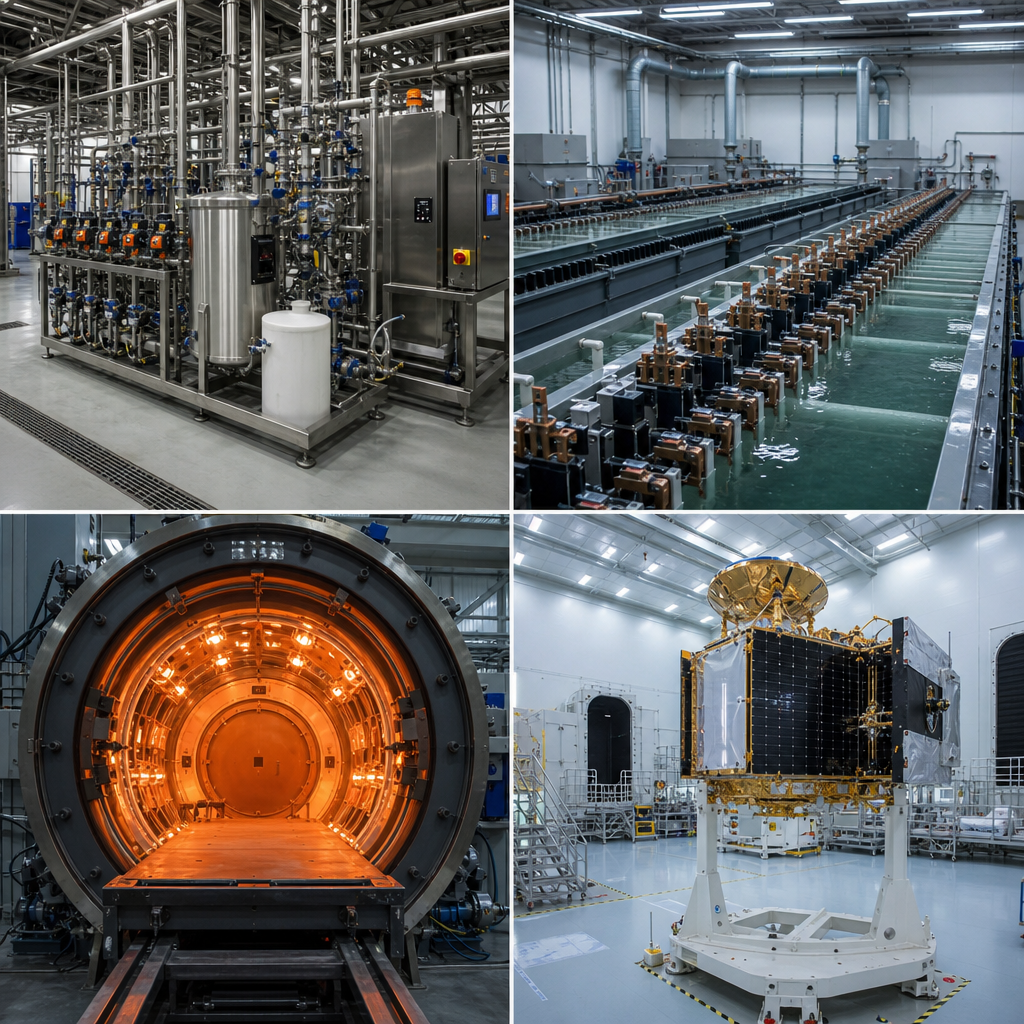
Demand context: USGS notes that CHIPS Act–driven expansion of U.S. semiconductor capacity is expected to increase tantalum demand, reinforcing the structural tightness described in Section 4.
6. Specifying a Tantalum-Tungsten Spring: A Practical Checklist
Before releasing a drawing for a refractory metal spring, confirm the following:
- Environment verified as genuinely hostile — hot concentrated mineral acid, or vacuum/inert high temperature. If stainless or Inconel is viable, use it.
- Fluoride and alkali compatibility checked — Ta-W is unsuitable for HF, fluoride-bearing media, fuming sulfuric acid with free SO₃/SO₂, and hot concentrated alkalis.
- Atmosphere specified for high-temperature service — vacuum, inert gas, or coated. Never specify a temperature without it.
- Grade correctly named — Ta-10W is UNS R05255; material certified to ASTM B365. Do not state ASTM F560 for an alloyed grade.
- Fatigue requirement assigned to test, not to a handbook — specify ASTM E466 / E606 testing if cycle life is design-critical.
- Mass and stiffness impact accepted — density is approximately 2× steel; elastic modulus is unchanged in magnitude.
- Commercial terms structured for volatility — lead time, price validity and indexation agreed up front.
- Surface and edge quality controlled in the drawing — the dominant fatigue-initiation site in any spring is still the surface and edge condition.
7. Frequently Asked Questions
Why are tantalum-tungsten springs so expensive?
Because both constituent metals are scarce, strategically controlled and price-volatile. The U.S. has zero domestic tantalum mine production and a 100% net import reliance for tantalum; China produces roughly 83% of the world’s tungsten. Both metals are on the U.S. Final 2025 List of Critical Minerals, and 25% tariffs were applied to both supply chains in September 2024. The price reflects feedstock scarcity and supply risk — not manufacturing markup alone.
What is the difference between tantalum and tantalum-tungsten?
Unalloyed tantalum (UNS R05200 / R05400, covered by ASTM F560 for implants) offers the highest corrosion resistance but lower strength. Adding 10% tungsten creates Ta-10W (UNS R05255), which per ASM International delivers higher room-temperature tensile strength (482 MPa min, annealed) and a higher elastic modulus (207 GPa) while retaining the corrosion behaviour. Note that ASTM F560 does not cover the alloyed grade.
Can a tantalum-tungsten spring be used in a human implant?
Unalloyed tantalum is well established in implant applications under ASTM F560. For a Ta-W alloy, that standard does not apply, and the regulatory pathway must be determined with the device manufacturer and the relevant notified body or regulator. Do not assume implant suitability from the base metal alone.
What is the maximum service temperature?
It depends entirely on atmosphere. In vacuum or inert atmosphere, Ta-10W can serve long-term above 1000°C (supplier-published data indicates approximately 200–400 MPa tensile strength retained at 1000°C). In air, uncoated service is limited by oxidation onset at approximately 600°C; beyond that, a protective coating is required. Any blanket “1000°C” claim without an atmosphere qualifier is incorrect.
How long will a tantalum-tungsten spring last in fatigue?
There is no published S-N curve for tantalum-tungsten springs in the public domain, and no dedicated spring product standard exists. Fatigue life must therefore be established by application-specific testing to ASTM E466 (force-controlled) or ASTM E606 (strain-controlled). Treat any quoted cycle count without a test report with caution.
Is a tantalum-tungsten spring stiffer than a stainless steel spring?
No — the difference is negligible. Ta-10W’s elastic modulus (207 GPa per ASM International) is in the same range as stainless steel (approx. 193–200 GPa). Spring-rate design logic carries over from conventional materials. Ta-W is selected for environmental survivability, not for stiffness. Likewise, at 16.6–17 g/cm³ it is roughly twice as dense as steel, so it offers no lightweighting advantage.
What lead time should be expected?
Public data on tantalum-tungsten spring lead times was not identified during this research. Because both feedstocks are subject to export controls, tariffs and price volatility, lead time should be confirmed with the supplier per order and written into the commercial terms.
8. Why Specify Through Hengsheng Spring
Hengsheng Spring brings over 20 years of spring manufacturing experience to refractory and high-performance material projects, and approaches exotic-material spring work with the same discipline as its standard product lines:
- Standards-first engineering. Material certified to ASTM B365 (wire) or ASTM B708 (strip), with mechanical verification under ASTM E8 and fatigue testing available under ASTM E466 / E606.
- Application review before quotation. We will tell you when a tantalum-tungsten spring is not the right answer — including the fluoride, alkali and fuming-acid exclusions — because a correctly scoped project is worth more than a wrongly supplied order.
- Surface and edge engineering. Fatigue initiation begins at the surface. Edge condition and surface finish are controlled as a drawing requirement, not an afterthought.
- Coating and atmosphere coordination. We work through the vacuum / inert / coated decision with you so that the temperature specification is technically defensible.
- Commercial transparency. Given the volatility of tantalum and tungsten pricing, we structure lead times and price validity openly rather than hedging them silently into the unit price.
Working on a spring that keeps failing in a corrosive or high-temperature environment? Send us the service conditions — medium, concentration, temperature, atmosphere and cycle requirement — and our application engineers will confirm whether a tantalum-tungsten spring is warranted, or whether a more economical material will do the job.
Request a Material Selection Review | Contact Our Engineering Team
References
Standards
- ASTM B365 — Standard Specification for Tantalum and Tantalum Alloy Rod and Wire (current: B365-12(2019)). https://webstore.ansi.org/standards/astm/astmb365982004
- ASTM B708 — Standard Specification for Tantalum and Tantalum Alloy Plate, Sheet, and Strip. https://webstore.ansi.org/standards/astm/astmb70805
- ASTM B521 — Standard Specification for Tantalum and Tantalum Alloy Seamless and Welded Tubes.
- ASTM F560 — Standard Specification for Unalloyed Tantalum for Surgical Implant Applications (UNS R05200, UNS R05400), ASTM BOS Vol. 13.01.
- ASTM E8/E8M — Tension Testing of Metallic Materials. https://www.intertek.com/building/standards/astm-e8/
- ASTM E466 — Force-Controlled Constant Amplitude Axial Fatigue Tests of Metallic Materials.
- ASTM E606/E606M — Strain-Controlled Fatigue Testing.
Government and official agency documents
- U.S. Geological Survey, Mineral Commodity Summaries 2025 — Tantalum. https://pubs.usgs.gov/periodicals/mcs2025/mcs2025-tantalum.pdf
- U.S. Geological Survey, Mineral Commodity Summaries 2025 — Tungsten. https://pubs.usgs.gov/periodicals/mcs2025/mcs2025-tungsten.pdf
- U.S. Department of the Interior, Final 2025 List of Critical Minerals, Federal Register, 7 November 2025. https://www.federalregister.gov/documents/2025/11/07/2025-19813/final-2025-list-of-critical-minerals
Authoritative industry references
- ASM International, Refractory Metal Alloys (Ta-10W / UNS R05255 room-temperature tensile strength 482 MPa min; elastic modulus 207 GPa). https://dl.asminternational.org/technical-books/monograph/120/chapter/2267000/Refractory-Metal-Alloys
- ASM International, Superalloys: Alloying and Performance — Introduction (refractory metals retain high-temperature strength but have poor oxidation resistance). https://dl.asminternational.org/technical-books/monograph/136/chapter/2395971/Introduction
- Titan Metal Fabricators / H.C. Starck, Tantalum — The Obvious Choice (physical and mechanical properties; Nb/Ta/Ti/Zr strong-acid corrosion comparison; inert below 150°C). http://www.titanmf.com/wp-content/uploads/docs/Tantalum-Applications-and-Properties.pdf
- IAEA INIS, Materials Compatibility and Corrosion Issues (tantalum inert below 150°C to all concentrations of HCl, HNO₃, 98% H₂SO₄ and 85% H₃PO₄). https://inis.iaea.org/records/z3tjh-v9n56/files/24012155.pdf
Journals and market reports
- Corrosion Science (Elsevier) — “Effect of cold rolling on the corrosion behavior of Ta-4W alloy.” https://www.sciencedirect.com/science/article/abs/pii/S0010938X20310398
- IMARC Group, Tantalum Price Index / Tantalum Pricing Report (U.S. USD 502/kg; China 2025 Q4 USD 363/kg). https://www.imarcgroup.com/news/tantalum-price-index
- Avalon Advanced Materials, pre-feasibility announcement, May 2025 (tantalum oxide USD 255.63/kg). https://avalonadvancedmaterials.com/wp-content/uploads/2025/05/NR_11_09.pdf
Engineering references (supplier-published, indicative values)
- Fortu Tech — Ta-10W wire technical data (ASTM B365 mechanical requirements; 1000°C strength; oxidation temperature; tantalum-tungsten springs / chlorinator springs application). https://www.fortu-tech.com/tantalum/tantalum-tungsten-ta10w-alloy-wire.html
- XOT Metals — Tantalum Tungsten (Ta10W) Alloy (UNS grades; application fields). https://www.xotmetals.com/blog/tantalum-tungsten-ta10w-alloy-2/
- D.R. Templeman — Spring Materials (maximum service temperature comparison for spring materials). https://www.drtempleman.com/about-spring-materials
Data Credibility Note
Values in this article are graded by source strength:
- Standard / official agency values (ASTM, USGS, Federal Register, IAEA) are quoted directly and can be verified against the cited document.
- Authoritative industry values (ASM International, Titan Metal Fabricators / H.C. Starck) are cited with the publishing organisation.
- Supplier-published engineering values — including the 1000°C strength range, the approximately 600°C oxidation onset, and the comparative maximum service temperatures for stainless steel, 17-4PH and Inconel 718 — are marked ᴳ or described as supplier-published / typical, and should be confirmed against the applicable ASTM or ASM handbook value before formal design release.
Values not identified during research are explicitly stated as unavailable rather than estimated. Specifically: no dedicated international spring product standard, no public S-N fatigue curve, no published stress-relaxation curve and no authoritative absolute corrosion-rate table (mm/year with test conditions) for tantalum-tungsten springs were identified.