
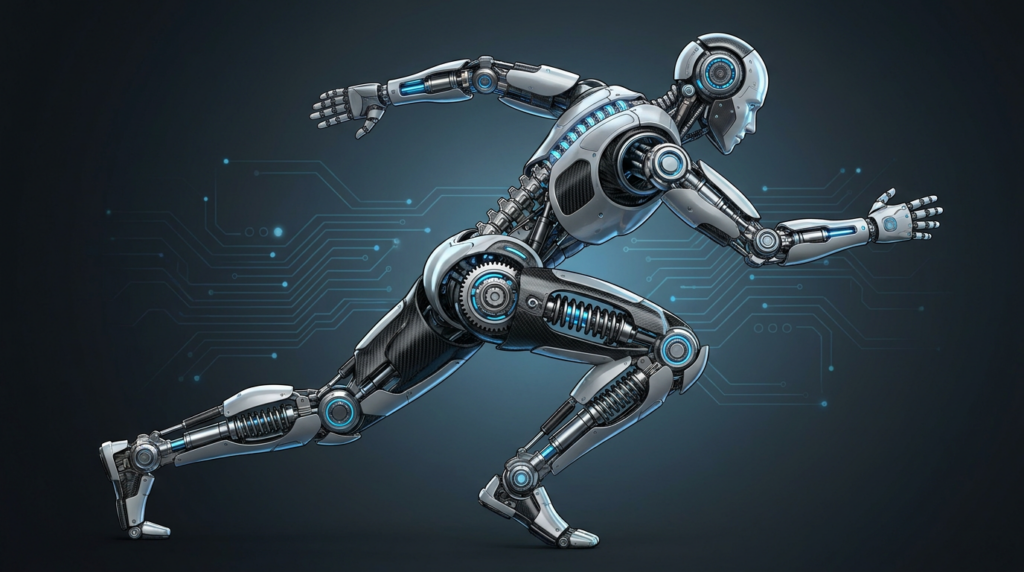
As humanoid robots transition from lab prototypes to real-world deployment in 2026, and consumer exoskeletons become the highlight of the tech world, a critical engineering realization has emerged: The “brain” of a robot is AI, but its “muscles” are high-precision springs.
At hengshengspring.com, with over 20 years of expertise in precision manufacturing, we are witnessing a paradigm shift. In the era of Physical AI, springs are no longer just hardware components—they are the key to safety, agility, and energy efficiency.
1. From Rigid Machines to Fluid “Physical AI”
Traditional industrial automation relied on rigid actuators. However, Physical AI—including humanoids and exoskeletons—must operate in unpredictable human environments.
The Core Engineering Value of Springs:
- Compliance & Safety: Springs provide “Passive Compliance,” allowing robots to absorb unexpected impacts and interact safely with humans.
- Energy Recovery: Much like human tendons, springs store energy during movement and release it during propulsion, significantly extending battery life.
- Torque Sensing: By measuring spring deflection, robots can achieve high-fidelity force feedback for delicate tasks.
2. Key Applications in Next-Gen Robotics
A. Series Elastic Actuators (SEA)
The “Heart” of humanoid joints. By integrating high-precision springs in series with motors, SEAs protect gearboxes from shock loads and enable smooth, human-like motion.
- Recommended Products: High-durability Torsion Springs or Compression Springs.
B. Exoskeleton Hip & Knee Modules
With the commercialization of exoskeletons (as seen at CES 2026), springs are vital for load-sharing and gait assistance.
- Material Focus: Ti-6Al-4V Titanium Alloy is preferred for its exceptional strength-to-weight ratio in wearable tech.
C. Soft Robotics & End-Effectors
Adaptive grippers use springs to handle fragile objects without the need for complex, heavy sensors.
- Recommended Solutions: Custom Flat Springs or Wave Springs for compact, lightweight integration.
3. Materials & Engineering for the 2026 Roadmap
Robotics engineering in 2026 demands tighter tolerances and specialized materials. Hengsheng Spring offers a specialized catalog for these high-growth sectors:
| Spring Type | Robotic Role | Why Hengsheng? |
| Wave Springs | Compact joint buffering | Saves 50% axial space compared to coil springs. |
| Titanium Springs | Lightweight Humanoids | Aerospace-grade Ti-6Al-4V for 40% weight reduction. |
| Constant Force Springs | Cable-driven systems | Validated for millions of cycles to ensure longevity. |
| Medical-Grade Springs | Surgical & Rehab Robots | ISO 13485 compliant manufacturing standards. |
4. Partnering with Hengsheng Spring
At hengshengspring.com, we bridge the gap between AI design and mechanical reality.
- CAD Integration: We support SolidWorks (SW) modeling and simulation to help you validate spring rates before prototyping.
- Rapid Prototyping: Accelerating your R&D cycle from concept to physical testing in record time.
- Precision Manufacturing: Our CNC-driven facility ensures that every spring meets the exact requirements of your sensor-fusion feedback loops.
Conclusion
2026 is the year robots change the world. From the logistics floor to the surgical suite, Hengsheng Spring provides the elastic foundation for the future of Physical AI.
Explore our technical specifications and request a quote at: hengshengspring.com