
In modern mechanical and industrial design, the demand for smaller, lighter, and more efficient components continues to grow. Among these innovations, the wave spring has emerged as a powerful alternative to traditional coil compression springs. With its unique wave-like structure, this compact spring design offers significant advantages in performance and space efficiency. Below are the three major advantages that make wave springs an essential component in advanced engineering applications.
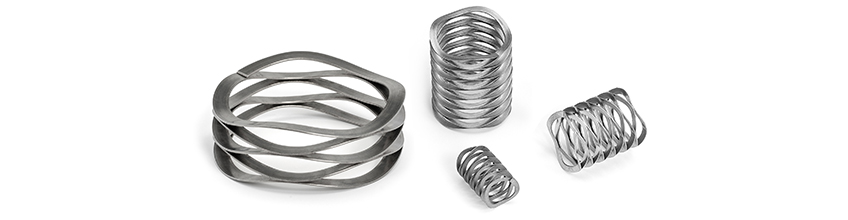
1. Space Saving Design
The most remarkable feature of a wave spring is its ability to provide the same spring force as a traditional coil spring, but in half the axial space.
- Compact efficiency: According to data from the Spring Manufacturer Institute (SMI), wave springs can reduce working height by up to 50% compared with standard compression springs while maintaining equivalent load capacity.
- Ideal for tight assemblies: This makes them highly suitable for compact systems such as bearing preloads, valves, connectors, and medical devices, where space is limited and precision is critical.
- Example: In ball bearing applications, a wave spring replaces conventional shims or washers, reducing assembly height while ensuring consistent axial load.
2. Stable and Predictable Performance
Wave springs are precision-engineered to deliver consistent, linear load characteristics throughout their deflection range.
- Smooth load curve: Their load-deflection behavior is predictable and easily controlled, ensuring stable force output under dynamic or static conditions.
- Reduced vibration and noise: The broad contact surfaces of the wave structure help absorb minor vibrations and minimize frictional noise during operation.
- High fatigue resistance: Manufactured from premium materials such as stainless steel, Inconel, and carbon steel, and treated with precise heat processes, wave springs offer excellent fatigue life and corrosion resistance.
Studies published in the ASM Handbook (Vol. 1, 2017) indicate that properly designed wave springs can endure over one million load cycles without significant performance degradation — making them ideal for long-life mechanical systems.
3. Easy Assembly and Flexible Customization
Beyond performance, wave springs simplify installation and allow for tailored engineering solutions.
- Variety of designs: Single-turn, multi-turn, nested, and interlaced wave springs can be configured to handle different load and deflection requirements.
- Automation-friendly: Their flat, compact geometry makes them suitable for modern automated assembly processes.
- Highly customizable: Designers can modify the number of waves, material thickness, wave height, and spring diameter to achieve specific performance targets without increasing part count or assembly complexity.
For example, Smalley’s Nested Wave Spring series demonstrates how stacking multiple layers can achieve higher load capacities without increasing installation space.
Conclusion
| Advantage | Key Benefit |
|---|---|
| Space Efficiency | Reduces spring height by 30–50% while maintaining force output |
| Performance Stability | Offers smooth load curve, low noise, and long fatigue life |
| Design Flexibility | Supports custom configurations for diverse engineering needs |
In summary, wave springs combine compact design, high precision, and adaptability, making them an indispensable solution for engineers pursuing efficiency without compromise. As industries continue to move toward miniaturization and smarter mechanical systems, wave springs stand as a prime example of how intelligent design can deliver powerful performance in minimal space.

References:
- Spring Manufacturer Institute (SMI) – Technical Handbook, 2019.
- ASM International, ASM Handbook, Vol. 1: Materials Engineering, 2017.
- Smalley Steel Ring Company – Wave Spring Technical Data Sheets, 2023.