
Introduction
In spring design, engineers rarely select a spring type based on convention alone. Instead, they evaluate load requirements, available space, fatigue life, and long-term reliability. As mechanical systems continue to demand higher performance, the limitations of traditional round wire springs become increasingly apparent.
Consequently, many engineers turn to flat wire springs when designs require higher loads, longer service life, or compact installation envelopes. In this article, we examine the engineering differences between flat wire springs and round wire springs, with a particular focus on stress behavior and fatigue life, supported by classical spring theory.
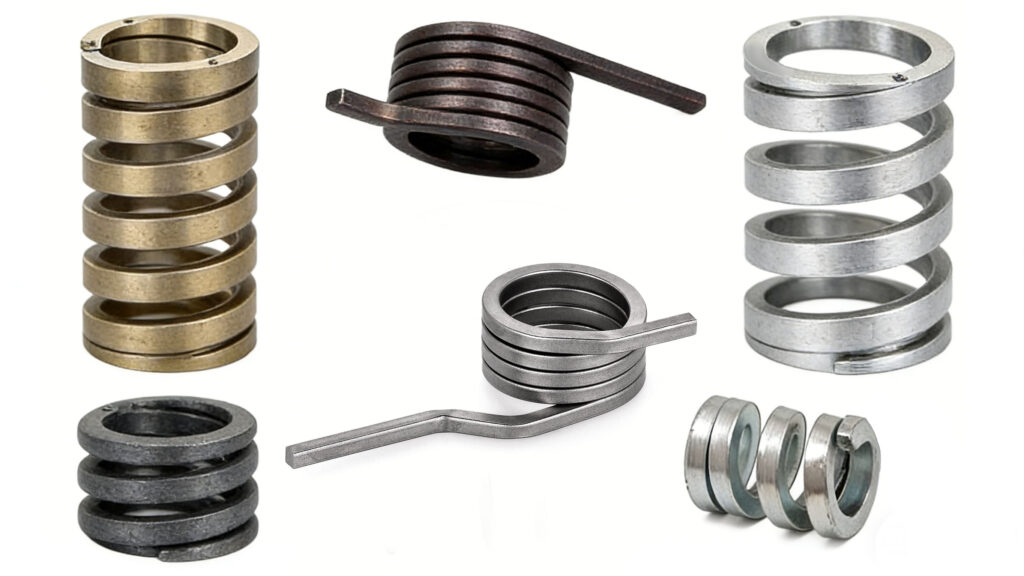
1. Fundamental Difference: Wire Cross-Section Geometry
At the most basic level, the difference between these two spring types lies in wire geometry.
- Round wire springs use a circular cross-section.
- Flat (or square) wire springs use a rectangular or square cross-section.
From an engineering perspective, this geometric distinction directly influences stress distribution, load capacity, and energy efficiency. Therefore, wire shape plays a decisive role in spring performance rather than serving as a secondary design detail.
2. Stress Analysis: Formula-Based Engineering Comparison
2.1 Stress in Round Wire Springs
Engineers typically calculate the maximum shear stress in a round wire compression spring using the following equation:τround=Kw⋅πd38FD
Where:
- τ = maximum shear stress
- F = applied load
- D = mean coil diameter
- d = wire diameter
- Kw = Wahl correction factor
However, round wire springs inherently suffer from stress concentration due to coil curvature and direct shear effects. As a result, engineers must introduce the Wahl correction factor to account for these phenomena.
Moreover, when the spring index C=D/d decreases, the Wahl factor increases rapidly. Consequently, peak stress rises sharply, which directly reduces fatigue life in high-load or compact designs.
2.2 Stress Characteristics of Flat Wire Springs
In contrast, flat wire springs distribute stress over a larger effective area. Although stress calculations depend on specific geometry, engineers often approximate the maximum shear stress as:τflat∝bt2FD
Where:
- b = wire width
- t = wire thickness
Because engineers can increase the load-bearing area by adjusting width and thickness, flat wire springs generate lower peak stress under the same load conditions. Therefore, stress concentration becomes significantly less severe than in round wire springs.
2.3 Stress Distribution Comparison
| Aspect | Round Wire Springs | Flat Wire Springs |
|---|---|---|
| Peak stress location | Inner wire surface | More evenly distributed |
| Stress concentration | High | Lower |
| Sensitivity to geometry | High | Moderate |
As a result, flat wire springs offer a clear advantage when engineers must control stress levels in demanding applications.
3. Fatigue Life: Engineering Implications
Engineers usually evaluate fatigue performance using stress–life (S–N) relationships:Nf∝(τmax1)m
Where:
- Nf = number of fatigue cycles
- τmax = maximum shear stress
- m = material fatigue exponent
Because fatigue life depends strongly on stress amplitude, even a modest reduction in peak stress produces a substantial improvement in durability. Therefore, flat wire springs often achieve multiple times the fatigue life of comparable round wire designs.
Furthermore, engineers find it easier to validate flat wire springs in high-cycle applications exceeding 106 cycles, especially in automotive and industrial systems.
4. Load Capacity and Space Efficiency
In addition to fatigue performance, engineers must consider energy storage and packaging constraints. The stored elastic energy follows:U=21Fδ
Because flat wire springs support higher loads within the same deflection range, they deliver greater energy density. Consequently, engineers can achieve:
- Higher force output without increasing spring diameter
- Shorter free length for identical working loads
- Improved space utilization in compact assemblies
Therefore, flat wire springs become the preferred solution in space-limited mechanical systems.
5. Design Flexibility and Spring Rate Control
Round Wire Springs
For round wire springs, engineers mainly control the spring rate through:
- Wire diameter d
- Mean coil diameter D
- Number of active coils n
However, these parameters offer limited flexibility without significantly increasing size.
Flat Wire Springs
By contrast, flat wire springs allow engineers to fine-tune stiffness using:
- Width-to-thickness ratio
- Section orientation
- Optimized material utilization
As a result, flat wire springs provide superior control over force curves and load consistency.
6. Manufacturing and Engineering Trade-Offs
| Factor | Round Wire Springs | Flat Wire Springs |
|---|---|---|
| Manufacturing complexity | Low | Higher |
| Unit cost | Lower | Higher |
| Fatigue performance | Moderate | Excellent |
| High-load capability | Limited | Superior |
Although flat wire springs involve more complex manufacturing, engineers often prioritize system reliability over component cost. Therefore, in safety-critical or high-value systems, flat wire springs justify their use.
7. Engineering Selection Guidelines
Engineers typically select round wire springs when:
- Space is sufficient
- Loads remain moderate
- Cost sensitivity dominates
Conversely, engineers favor flat wire springs when:
- Installation space is limited
- Loads or cycle counts are high
- Long-term performance stability is critical
Conclusion
In summary, the engineering distinction between flat wire springs and round wire springs centers on stress management and fatigue life. By reducing peak stress and improving load efficiency, flat wire springs deliver superior durability and performance in demanding applications.
At Hengsheng Spring, we support engineers with custom flat wire spring solutions, from design analysis to precision manufacturing. Our expertise ensures optimized geometry, controlled stress levels, and reliable long-term performance.
Contact Hengsheng Spring to discuss your flat wire spring requirements and receive engineering support tailored to your application.