
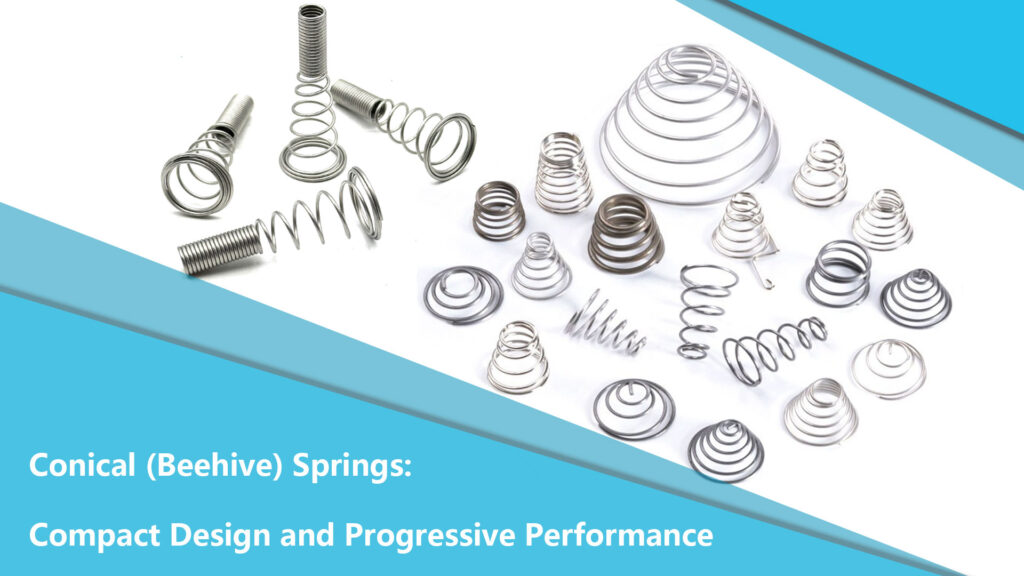
Conical springs, also known as beehive springs or tapered compression springs, are a specialized form of helical compression spring designed with a gradually changing coil diameter. Unlike conventional cylindrical compression springs, conical springs offer a unique combination of space efficiency, progressive force characteristics, and superior stability, making them ideal for applications where both performance and compactness are critical.
What Are Conical (Beehive) Springs?
A conical spring is shaped like a cone, with one end larger in diameter than the other. This geometry allows the coils to nest into one another during compression, significantly reducing the solid height and providing a progressive spring rate. The result is a spring that can store more energy in a smaller space and maintain better alignment under load.
Commonly referred to as beehive springs due to their shape, these components are widely used in automotive engines, industrial machinery, and electromechanical systems that demand both strength and precision.
Key Advantages of Conical Springs
- Progressive Spring Rate
Unlike cylindrical springs, which have a constant spring rate, conical springs provide a gradually increasing stiffness as they compress. This feature helps absorb shock loads more smoothly and prevents sudden coil binding. - Space Efficiency
The nested coil design allows a shorter solid height compared to straight compression springs, making them ideal for space-limited assemblies such as valve systems or compact actuators. - Improved Stability and Anti-Buckling
The tapered geometry enhances axial stability, minimizing lateral deflection and vibration during operation. This results in quieter and longer-lasting performance. - Reduced Mass and Dynamic Load
Especially in automotive engines, beehive valve springs reduce the top coil mass, improving valve control at high RPM and extending component life.
Applications Across Industries
Conical springs are used in numerous fields due to their unique combination of compactness and performance:
- Automotive Engineering: Beehive valve springs improve valve timing accuracy and high-speed operation.
- Battery Contacts: Maintain stable electrical contact in compact devices.
- Industrial Tools: Applied in precision mechanisms and sealing systems where space and load balance are key.
- Aerospace Components: Used in vibration-damping and motion-control assemblies.
- Consumer Electronics: Provide smooth actuation and stability in switches and connectors.
(References: Murata Spring Co., 2022; Lesjöfors Spring Design Handbook, 2021)
Comparison: Conical vs. Cylindrical Compression Springs
| Property | Conical Spring | Cylindrical Spring |
|---|---|---|
| Spring Rate | Progressive | Linear |
| Space Efficiency | High | Medium |
| Buckling Resistance | Excellent | Moderate |
| Solid Height | Up to 50% shorter | Standard |
| Dynamic Stability | Superior | Standard |
According to data published in the ASM Handbook, Vol. 1: Materials Engineering (2017), conical valve springs can achieve a fatigue life exceeding 10 million cycles under high-stress conditions (>900 MPa), demonstrating exceptional durability and reliability.
Manufacturing and Quality Control
Producing conical springs requires precision CNC coiling technology to ensure accurate taper angles, coil spacing, and consistent performance. Advanced processes like heat treatment, shot peening, and surface polishing are essential for achieving optimal fatigue life and load stability.
Modern manufacturers maintain dimensional tolerances within ±0.1 mm and surface roughness below Ra 0.8 μm to guarantee product uniformity, especially for automotive-grade applications.
(Source: Journal of Mechanical Design, 2020)
When to Choose a Conical Spring
Engineers and designers typically select conical springs when:
- There is limited installation space and a reduced solid height is needed.
- A progressive load response is required for better control.
- The design demands vibration resistance or anti-buckling performance.
- High-speed or dynamic load environments require stability and precision.
Conclusion
The conical (beehive) spring represents the evolution of compression spring design—offering engineers a balance between strength, space, and performance. Whether in high-performance engines, compact industrial assemblies, or precision electronic systems, this small but powerful component plays a vital role in advancing modern mechanical design.
References
- ASM International, ASM Handbook Vol.1: Materials Engineering, 2017.
- Lesjöfors, Spring Design Handbook, 2021.
- Murata Spring Co., Beehive Valve Spring Technical Guide, 2022.
- Journal of Mechanical Design, Comparative Study of Helical and Tapered Compression Springs, 2020.
- MotorTrend, Conical Valve Springs: Design & Performance, 2023.