
Introduction
Computer Numerical Control (CNC) machining is a cornerstone of modern manufacturing, enabling high precision, repeatability, and efficiency across a wide range of industries. By using computer-controlled instructions to guide cutting tools and machine movements, CNC machining allows manufacturers to produce complex parts with tight tolerances that are difficult or impossible to achieve using conventional manual methods.
CNC machining is extensively applied in the automotive, aerospace, medical, electronics, and industrial equipment sectors. According to multiple manufacturing studies, CNC-based production significantly improves dimensional accuracy, reduces human error, and enhances overall process stability compared to traditional machining methods.
Core Types of CNC Machining Processes
1. CNC Turning
CNC turning is primarily used to manufacture rotational or axisymmetric components. In this process, the workpiece rotates at high speed while a stationary cutting tool removes material.
Typical operations include:
- External and internal diameter turning
- Facing and grooving
- Thread cutting
Common applications:
- Shafts and pins
- Bushings and sleeves
- Cylindrical connectors
Academic studies published in Modern Manufacturing Technology indicate that CNC turning offers superior concentricity and roundness control, making it ideal for high-precision shaft components.
2. CNC Milling
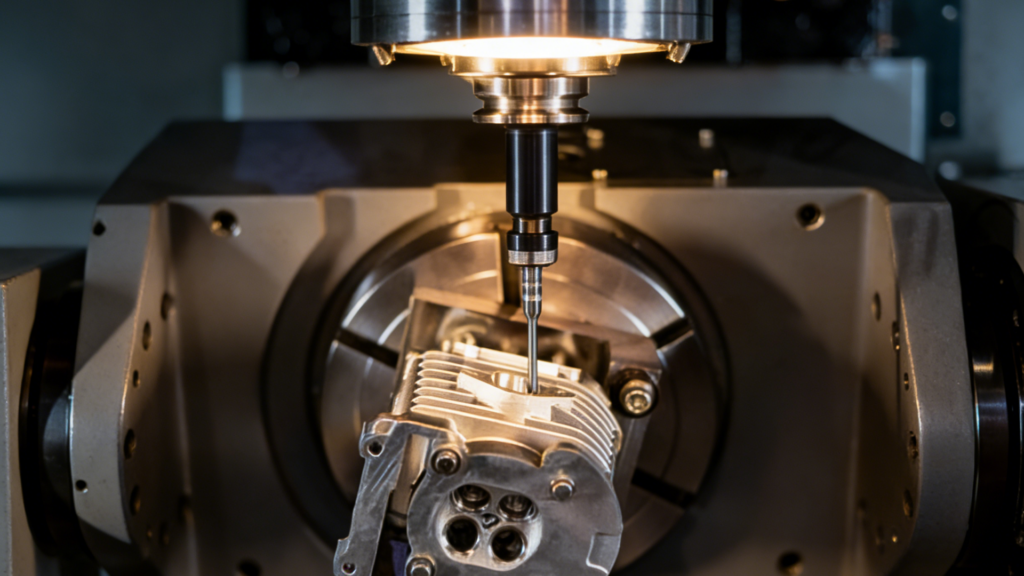
CNC milling employs a rotating cutting tool that moves along multiple axes to remove material from a stationary workpiece. This process is widely used for producing prismatic and complex-shaped parts.
Capabilities include:
- Flat surface machining
- Slot and pocket machining
- Complex 3D contouring
With the development of 4-axis and 5-axis CNC machining centers, milling can now produce highly complex geometries in a single setup, reducing cumulative positioning errors and improving overall efficiency.
3. CNC Drilling, Reaming, and Tapping
Hole-making operations are among the most common CNC machining processes. CNC drilling is often followed by reaming for improved dimensional accuracy or tapping to create internal threads.
Applications include:
- Fastener holes
- Assembly alignment holes
- Threaded connection features
Industry reports highlight that CNC-controlled hole machining ensures consistent hole positioning and depth, which is critical for automated assembly lines.
4. CNC Boring
CNC boring is used to refine existing holes to achieve high dimensional accuracy and precise positional relationships.
Key characteristics:
- High accuracy in hole diameter and alignment
- Essential for large or deep holes
- Often applied after drilling or casting
Boring operations are commonly used in engine blocks, gear housings, and structural mechanical components where strict tolerance control is required.
5. CNC Grinding
CNC grinding is typically applied as a finishing process to achieve ultra-high precision and superior surface quality.
Grinding types include:
- Surface grinding
- Cylindrical grinding
- Internal grinding
Research published in Journal of Manufacturing Processes notes that CNC grinding can achieve surface roughness values as low as Ra 0.2 μm, making it indispensable for precision and wear-critical components.
Advanced and Auxiliary CNC Machining Technologies
Multi-Axis CNC Machining (4-Axis and 5-Axis)
Multi-axis CNC machining allows the cutting tool to approach the workpiece from multiple angles, enabling:
- Single-setup multi-face machining
- Reduced fixture changes
- Higher geometric accuracy
This technology is especially valuable in aerospace, medical, and high-end automotive applications.
Turn-Mill (Mill-Turn) Machining
Turn-mill machining integrates turning and milling operations into a single machine. This hybrid approach reduces handling time, improves precision, and shortens production cycles.
CAD/CAM Integration in CNC Machining
Modern CNC machining relies heavily on CAD/CAM systems to generate toolpaths and optimize machining parameters. Academic literature demonstrates that CAD/CAM integration significantly improves machining efficiency and reduces tool wear through optimized cutting strategies.
Comparison of CNC Machining Processes
| Process Type | Main Motion | Typical Equipment | Suitable Parts | Key Advantages |
|---|---|---|---|---|
| CNC Turning | Rotating workpiece | CNC Lathe | Shafts, bushings | High concentricity |
| CNC Milling | Multi-axis tool motion | Machining center | Complex geometries | High flexibility |
| CNC Drilling | Axial tool feed | CNC drill/mill | Holes, threads | Accuracy & consistency |
| CNC Boring | Precision hole finishing | Boring machine | Engine housings | High hole accuracy |
| CNC Grinding | High-speed abrasive wheel | CNC grinder | Precision surfaces | Ultra-fine surface finish |
Quality Control and Process Optimization
Quality control in CNC machining involves monitoring dimensional accuracy, surface finish, and process stability. Studies published in engineering journals emphasize the importance of controlling cutting parameters, tool wear, and machine rigidity to ensure consistent output quality.
In recent years, research has also focused on optimizing CNC machining for energy efficiency and cost reduction. Multi-objective optimization methods, combining machining performance with sustainability considerations, are increasingly adopted in advanced manufacturing environments.
Conclusion
CNC machining encompasses a wide range of processes, each tailored to specific geometries, tolerance requirements, and production volumes. From turning and milling to grinding and multi-axis machining, CNC technologies form the backbone of precision manufacturing. Understanding the characteristics and applications of each CNC process enables engineers, buyers, and manufacturers to select optimal machining strategies and achieve superior product quality.
References
- Agrisa, H. H. “An Overview of CNC Machining Processes.” Journal of Mechanical Science and Engineering.
- Zhao, N. “Research on CNC Turning Process Optimization.” Modern Manufacturing Technology.
- Li, J. et al. “Optimization of Milling Parameters Using Response Surface Method.” Manufacturing Technology & Machine Tools.
- JS Precision CNC. “A Comprehensive Guide to CNC Milling Machining.”
- Worthy Hardware. “Types of Machining Processes in CNC Manufacturing.”
- Kalpakjian, S., Schmid, S. Manufacturing Engineering and Technology. Pearson Education.
- Journal of Manufacturing Systems. “Multi-objective Optimization in CNC Machining.”
- Journal of Manufacturing Processes. “Surface Integrity and Precision in CNC Grinding.”
- Wikipedia. “Machining and Cutting Processes.”