
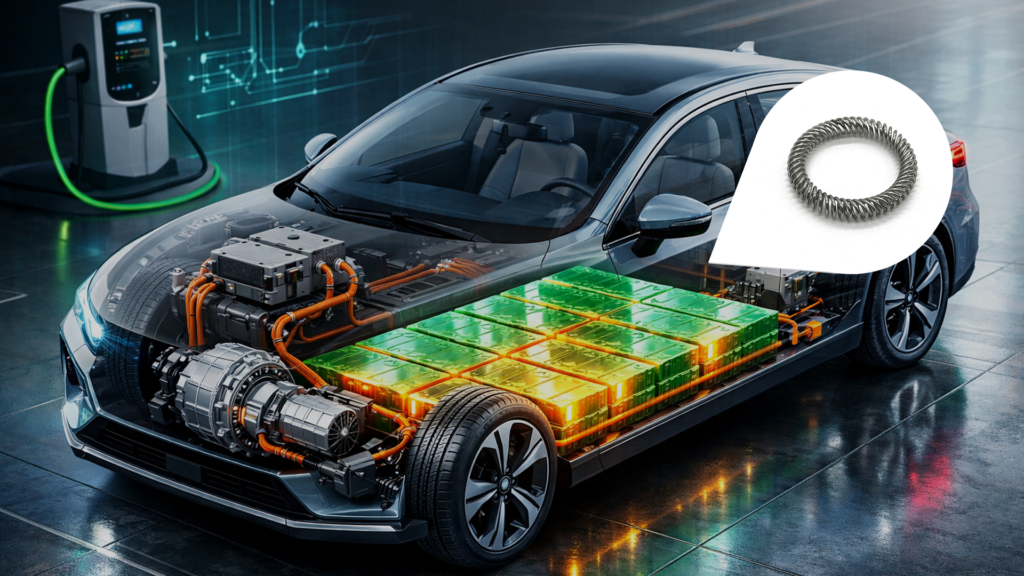
Addressing the Dual Challenge of Electrical Conductivity and EMI Shielding
1. From Commodity Components to System-Critical Elements
Historically, springs have been treated as standardized mechanical components, primarily responsible for energy storage, preload, or mechanical return. However, in high-reliability vertical industries such as electric vehicles (EVs), energy storage systems, and power electronics, this perception is rapidly changing.
As EV architectures evolve toward higher voltage platforms, tighter packaging, and increased functional integration, springs are no longer passive components. Instead, they are becoming system-critical elements that directly influence electrical performance, thermal reliability, vibration tolerance, and electromagnetic compatibility (EMC).
Among these advanced spring solutions, Canted Coil Springs stand out as a highly engineered answer to the growing demands of EV battery systems.
2. Engineering Challenges in EV Battery Pack Interconnections
2.1 Beyond Simple Electrical Continuity
Within an EV battery pack and its Battery Management System (BMS), electrical connections must perform reliably under a combination of harsh operating conditions:
- High current transmission with ultra-low contact resistance
- Repeated thermal cycling (typically −40°C to +120°C or higher)
- Continuous vibration and mechanical shock
- Tight dimensional tolerances and stack-up variations
- Increasing EMI/RFI shielding requirements
Traditional interconnection methods—such as bolted joints, welded tabs, or stamped contact springs—often struggle to maintain stable performance throughout the vehicle’s lifetime. Common failure modes include:
- Loss of contact force due to relaxation or creep
- Increased contact resistance caused by oxidation or micro-motion
- Fatigue cracking under thermal and vibrational stress
- Difficult rework or maintenance
These challenges have accelerated the adoption of compliant, self-compensating interconnect solutions, where Canted Coil Springs play a critical role.
3. Understanding Canted Coil Spring Technology
3.1 Structural Characteristics and Functional Advantages
A Canted Coil Spring consists of individual coils arranged at a fixed inclination angle rather than perpendicular to the spring axis. This distinctive geometry provides several engineering benefits:
- Independent coil deflection, enabling uniform load distribution
- Large elastic working range, maintaining consistent contact force
- Multiple contact points, improving electrical continuity and redundancy
- Low spring rate variation, even under compression and thermal cycling
From an electrical and mechanical standpoint, this structure makes Canted Coil Springs particularly suitable for applications requiring stable force and low resistance over time.
4. Deep Application Cases in EV Battery Systems
4.1 Battery Module to Busbar Electrical Connections
In high-current paths between battery modules and busbars, Canted Coil Springs provide a compliant interface that:
- Maintains constant contact pressure despite thermal expansion mismatch
- Reduces dependency on high assembly torque
- Compensates for manufacturing tolerances and misalignment
Unlike rigid bolted connections, the spring continuously adapts to dimensional changes, ensuring long-term electrical reliability.
4.2 Low-Current Signal Contacts in BMS Architecture
BMS systems rely on precise voltage and temperature sensing, where even minor contact instability can introduce noise or signal drift.
Canted Coil Springs are widely used in:
- Signal pin interfaces
- Monitoring connectors
- Sensor grounding paths
Their consistent normal force minimizes micro-fretting and contact bounce, significantly improving signal integrity under vibration.
4.3 EMI / RFI Shielding in Battery Pack Enclosures
One of the most underappreciated yet critical applications of Canted Coil Springs in EVs is electromagnetic shielding.
When installed along enclosure seams, access panels, or connector interfaces, these springs provide:
- Continuous 360-degree conductive paths
- Simultaneous mechanical compliance and grounding
- Reliable shielding effectiveness across wide frequency ranges
This dual-function capability allows designers to integrate conductivity, shielding, and tolerance compensation into a single component—reducing system complexity and part count.
5. Why Canted Coil Springs Are Well-Suited for EV Platforms
From a system engineering perspective, the advantages extend beyond individual performance metrics:
| EV Requirement | Engineering Benefit of Canted Coil Springs |
|---|---|
| Thermal cycling resistance | Self-adjusting contact force |
| Vibration durability | Multi-point electrical contact |
| Tight packaging | Compact axial and radial profiles |
| Serviceability | Non-permanent, rework-friendly interfaces |
| EMC compliance | Integrated grounding and shielding |
As EV architectures move toward 800V systems, fast-charging capabilities, and higher EMC standards, these attributes become increasingly critical.
6. Redefining the Role of Spring Suppliers in the EV Industry
In modern EV development, Canted Coil Springs are no longer selected as off-the-shelf components. Instead, they are often co-designed with OEMs and Tier 1 suppliers to address:
- Contact force optimization
- Material and plating selection for conductivity and corrosion resistance
- Shielding effectiveness requirements
- Lifetime reliability validation
This shift elevates spring manufacturers from component suppliers to engineering solution partners.
7. Conclusion: Small Components, Large System Impact
The competitiveness of electric vehicles increasingly depends on system reliability, safety, and electromagnetic performance. Within the battery pack—the heart of the EV—Canted Coil Springs provide an elegant solution to the dual challenges of electrical conduction and EMI shielding.
As EV technology continues to evolve, the depth of application for Canted Coil Springs will only expand, reinforcing their position as a high-value, high-barrier component in next-generation electric vehicle platforms.