
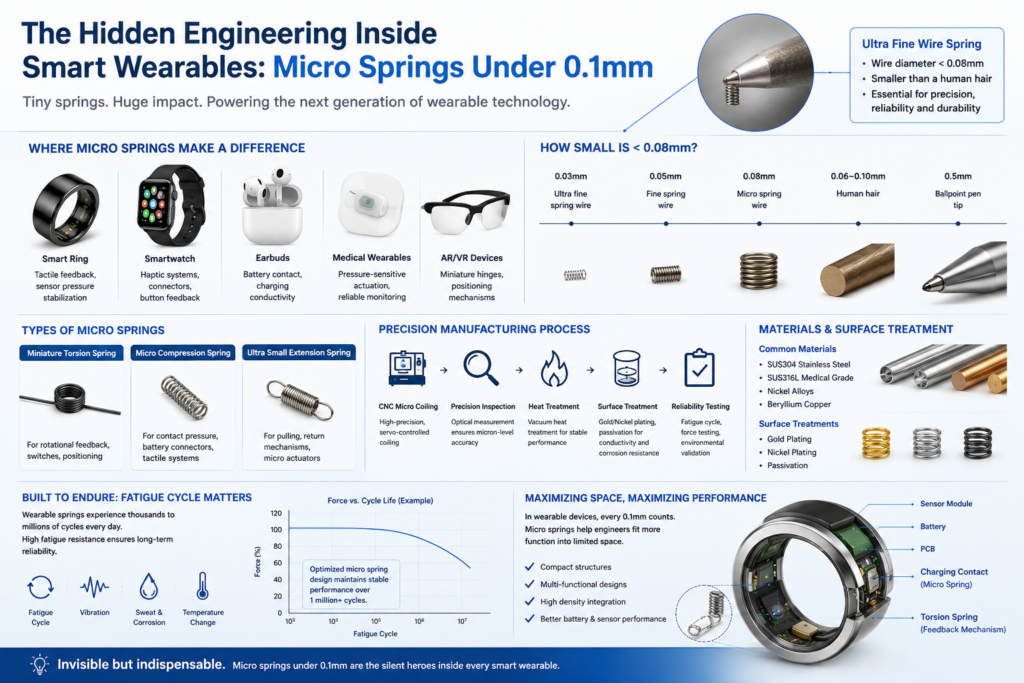
As wearable technology evolves from simple fitness trackers into highly integrated intelligent devices, engineers are facing a new challenge: how to fit reliable mechanical systems into spaces smaller than ever before.
From smart rings and health-monitoring patches to AR glasses and compact medical wearables, one tiny component is quietly enabling this revolution — the micro precision spring.
Although often invisible to consumers, these springs are essential for tactile feedback, electrical conductivity, pressure control, structural movement, and durability. In many next-generation wearables, the spring wire diameter is now below 0.08mm, approaching the scale of human hair.
This is the hidden engineering inside modern wearable devices.
Why Smart Wearables Depend on Micro Springs
Modern wearable products demand four things simultaneously:
- Miniaturization
- Lightweight structures
- Long-term durability
- Precision mechanical response
Traditional spring designs used in automotive or industrial products cannot simply be scaled down. At the micro level, material behavior, fatigue performance, and manufacturing tolerances become significantly more complex.
This is where the wearable device spring industry has rapidly advanced.
Typical applications include:
| Wearable Device | Spring Function |
|---|---|
| Smart rings | Button feedback, sensor pressure stabilization |
| Earbuds | Battery contact and charging conductivity |
| Smartwatches | Haptic mechanisms and connector systems |
| Medical wearables | Pressure-sensitive actuation |
| AR/VR devices | Miniature hinge and positioning systems |
In many cases, the entire mechanical movement inside the device relies on springs measuring only a few millimeters in size.
The Rise of Ultra Fine Wire Springs
One of the most critical developments in wearable engineering is the use of ultra fine wire spring technology.
Today’s advanced micro springs can use wire diameters below:
- 0.10mm
- 0.08mm
- 0.05mm
- Even 0.03mm in specialized medical electronics
For comparison, a human hair is typically around 0.06–0.10mm thick.
At this scale, conventional spring manufacturing methods become unstable. Minor deviations in coiling tension or heat treatment can dramatically affect spring force consistency.
As a result, manufacturers increasingly rely on:
- CNC micro coiling systems
- Precision optical inspection
- Automated tension control
- Vacuum heat treatment
- Micro laser measurement technology
The entire process requires an environment closer to semiconductor manufacturing than traditional spring production.
CNC Micro Coiling: Manufacturing at the Micron Level
Producing a micro precision spring is not simply “making a smaller spring.”
When wire diameter drops below 0.08mm, several engineering problems emerge:
1. Material Elastic Instability
Ultra-thin wire becomes highly sensitive to:
- Ambient vibration
- Coiling speed fluctuations
- Surface defects
- Residual internal stress
Even microscopic scratches can reduce fatigue life dramatically.
2. Tooling Precision Requirements
Traditional coiling tools wear too quickly at this scale.
Micro spring manufacturers often use:
- Diamond-coated tooling
- High-speed servo-controlled CNC systems
- Precision guide pin alignment within microns
3. Thermal Control Challenges
Heat treatment becomes extremely delicate because excessive temperature may:
- Alter spring force
- Reduce elasticity
- Cause brittleness
- Introduce dimensional distortion
Therefore, micro coiling production lines usually integrate fully controlled thermal environments.
Medical-Grade Stainless Steel: Why Material Selection Matters
Material selection becomes increasingly critical in wearable applications because these products maintain direct contact with human skin for extended periods.
The most commonly used materials include:
- SUS304 stainless steel
- SUS316L medical-grade stainless steel
- Nickel alloys
- Beryllium copper for conductive applications
Among them, medical-grade SUS316L has become particularly important for smart wearables because of its:
- Corrosion resistance
- Biocompatibility
- Sweat resistance
- Fatigue performance
- Long-term stability
For premium wearable electronics, manufacturers also apply:
- Gold plating
- Nickel plating
- Passivation treatments
These surface treatments improve:
- Electrical conductivity
- Oxidation resistance
- Contact reliability
- Cosmetic appearance
In devices such as smart rings, even the spring’s surface conductivity can directly affect sensor accuracy and charging stability.
The Critical Role of Miniature Torsion Springs in Smart Rings
The rapid growth of smart rings has created new demand for the miniature torsion spring industry.
Unlike larger wearables, smart rings offer almost no internal space. Every component must perform multiple functions simultaneously.
Inside many smart rings, micro torsion springs are used for:
- Rotational feedback mechanisms
- Sensor positioning
- Pressure balancing
- Charging contact stabilization
- Micro switch systems
Because the ring constantly experiences finger movement, temperature changes, and sweat exposure, the spring must survive continuous micro-deformation cycles without failure.
This creates enormous demands on:
- Fatigue cycle performance
- Torque consistency
- Dimensional tolerance
- Surface finish quality
In some premium wearable products, miniature springs are tested for millions of operational cycles before qualification.
Fatigue Cycle: The Biggest Reliability Challenge
For wearable electronics, spring failure is rarely caused by overload.
Instead, most failures occur due to fatigue.
A wearable spring may experience:
- Thousands of micro-movements per day
- Constant vibration
- Repeated charging cycles
- Environmental exposure
Over time, even tiny stress concentrations can lead to:
- Force decay
- Cracking
- Permanent deformation
- Contact instability
This is especially problematic for micro compression springs used in compact battery connectors and tactile systems.
To improve fatigue cycle performance, manufacturers focus heavily on:
Surface Quality
Micro scratches become critical crack initiation points.
Stress Distribution
Proper spring index design reduces localized stress concentration.
Shot Peening and Surface Treatment
Specialized micro-scale surface strengthening can improve fatigue resistance.
Precision Heat Treatment
Optimized thermal processing stabilizes the material’s internal structure.
High-end wearable device springs may undergo extensive cycle testing exceeding:
- 500,000 cycles
- 1 million cycles
- Multi-axis dynamic fatigue simulation
Reliability is now a competitive advantage in the wearable market.
Space Utilization: The Invisible Battle Inside Wearables
Miniaturization is not only about reducing component size.
It is about maximizing functional density.
Inside modern wearable electronics, engineers must fit:
- Sensors
- Batteries
- Antennas
- PCBs
- Wireless charging modules
- Cooling structures
- Mechanical components
…into extremely limited internal volume.
This is why smart ring spring design has become so specialized.
Engineers increasingly use:
- Nested spring structures
- Multi-functional conductive springs
- Flat wire micro springs
- Ultra-short compression springs
- Hybrid elastic contact systems
Every 0.1mm of saved space can significantly improve battery capacity or sensor integration.
In many wearable products, the spring is no longer just a mechanical part — it becomes part of the overall electronic architecture.
Future Trends in Wearable Spring Engineering
The next generation of wearable devices will continue pushing spring technology toward:
- Smaller diameters
- Higher fatigue resistance
- Better conductivity
- Improved biocompatibility
- Multi-functional integration
Emerging trends include:
AI Health Monitoring Devices
Requiring highly stable sensor-contact springs.
Flexible Wearables
Demanding ultra-elastic micro spring systems.
Medical Smart Rings
Needing implant-grade materials and precision force control.
Foldable Wearable Electronics
Creating new demand for compact torsion and hinge springs.
As wearable devices become more intelligent, spring engineering is becoming more sophisticated rather than less important.
Conclusion
Consumers rarely notice the tiny springs hidden inside wearable devices.
Yet without them, smart rings would lose tactile precision, earbuds would fail to charge reliably, and health-monitoring devices would struggle to maintain sensor accuracy.
The future of wearable innovation depends not only on software and sensors, but also on microscopic mechanical engineering.
And increasingly, that future is being shaped by micro precision springs under 0.1mm.