
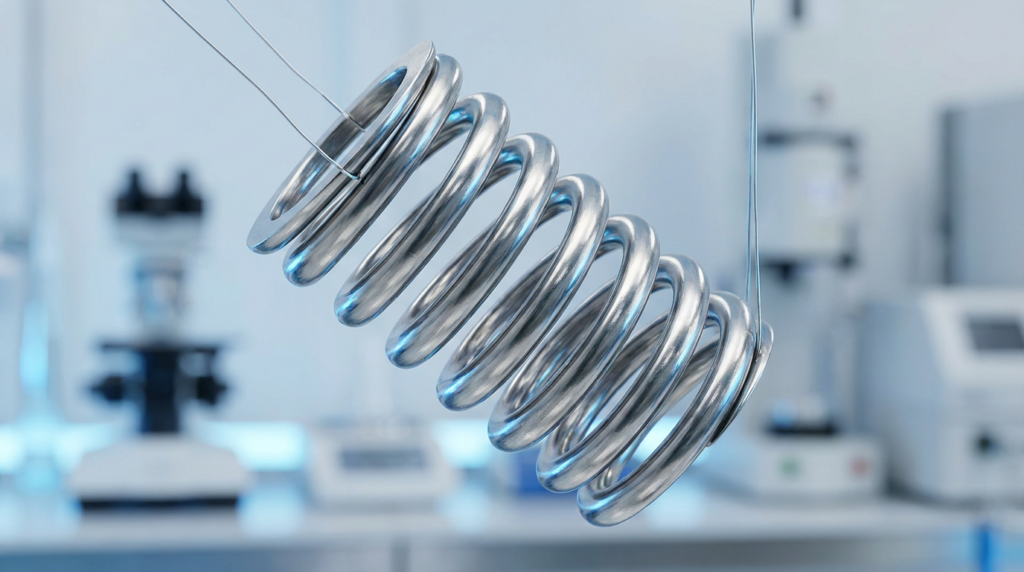
In the world of precision spring manufacturing, material selection dictates the boundaries of performance. While carbon steel and stainless steel remain the industry “workhorses,” the Ti-6Al-4V (Grade 5 / TC4) Titanium Alloy has emerged as the gold standard for high-end spring applications in aerospace, high-performance racing, and medical technology.
As a specialized spring manufacturer, we don’t just look at raw strength; we analyze how a material behaves under dynamic fatigue, corrosive environments, and extreme weight constraints.
1. Why Ti-6Al-4V? The “Golden Ratio” of Metallurgy
Ti-6Al-4V is an alpha-beta ($\alpha-\beta$) alloy containing 6% aluminum and 4% vanadium. In spring engineering, it offers a “triple threat” of properties:
- Extreme Strength-to-Weight Ratio: Titanium’s density is approximately 57% that of steel. When heat-treated, Ti-6Al-4V can reach tensile strengths exceeding $1100 \, \text{MPa}$. This allows for weight savings of over 40% compared to steel springs with the same spring rate.
- Low Elastic Modulus (Young’s Modulus): Titanium has a modulus of roughly $110 \, \text{GPa}$, nearly half that of steel ($210 \, \text{GPa}$). In spring design, a lower modulus means more energy storage per unit of weight and greater deflection capability.
- Superior Corrosion Fatigue: Unlike carbon steels that require heavy plating, Ti-6Al-4V forms a stable, protective oxide layer. Research in the Journal of Materials Engineering and Performance confirms its near-total immunity to chlorides and saltwater.
2. Comparative Analysis: Ti-6Al-4V vs. Steel vs. Stainless Steel
To help you choose the right material for your application, we have benchmarked Ti-6Al-4V against common spring materials like ASTM A228 (Music Wire) and 316 Stainless Steel.
| Property | Ti-6Al-4V (Grade 5) | Carbon Steel (Music Wire) | Stainless Steel (316) |
| Density ($g/cm^3$) | ~4.43 | ~7.85 | ~7.90 |
| Elastic Modulus ($GPa$) | 110 – 114 | 206 – 210 | 193 |
| Tensile Strength ($MPa$) | $\ge 895$ (Annealed) | 1600 – 2000+ | 1200 – 1500 (Cold Drawn) |
| Corrosion Resistance | Excellent (Acids/Sea) | Low (Needs Coating) | High |
| Max Operating Temp | $400^\circ\text{C}$ ($750^\circ\text{F}$) | $120^\circ\text{C}$ ($250^\circ\text{F}$) | $250^\circ\text{C}$ ($480^\circ\text{F}$) |
| Magnetic Property | Non-Magnetic | Strongly Magnetic | Non-Magnetic |
3. Manufacturing Challenges & Solutions
Producing a high-quality titanium spring is significantly more complex than coiling steel. At our facility, we address three critical factors:
- Springback Control: Due to the lower modulus, titanium exhibits much higher “springback” after coiling. We utilize precision CNC hot-coiling or specialized warm-working techniques to ensure dimensional accuracy.
- Surface Treatment: Titanium is prone to “galling” (wear caused by friction). We apply Shot Peening to induce compressive residual stress, which significantly boosts fatigue life, often followed by anodizing or DLC (Diamond-Like Carbon) coatings for wear resistance.
- Hydrogen Embrittlement: During chemical cleaning or processing, titanium can absorb hydrogen. Our vacuum-stress-relieving processes ensure the material remains ductile and avoids catastrophic failure.
4. Strategic Industry Applications
- Aerospace: Used in engine valve springs and landing gear components. Reducing weight in the engine core directly translates to higher fuel efficiency and lower emissions.
- Motorsport (F1/MotoGP): Suspension springs made of Ti-64 reduce “unsprung mass,” allowing the suspension to react faster to track irregularities, improving mechanical grip.
- Medical Implants: Using the ELI (Extra Low Interstitials / Grade 23) variant, these springs are used in orthopedic implants and cardiovascular devices due to their high biocompatibility and non-magnetic nature (MRI compatible).
Conclusion: Is the Investment Justified?
While the initial material cost of Ti-6Al-4V is higher than steel, the total cost of ownership is often lower in high-performance environments. The combination of weight reduction, zero maintenance (due to corrosion resistance), and high-temperature stability makes it the logical choice for critical engineering.
Would you like us to run a weight-saving simulation for your current spring design? Our engineering team is ready to help you transition from steel to titanium.
References & Literature
- Donachie, M. J. (2000). Titanium: A Technical Guide. ASM International. (The definitive guide for titanium mechanical properties).
- Boyer, R., Welsch, G., & Collings, E. W. (1994). Materials Properties Handbook: Titanium Alloys. ASM International. (Comprehensive data on Ti-6Al-4V fatigue and stress).
- ASTM B348 / B348M: Standard Specification for Titanium and Titanium Alloy Bars and Billets. (Global standard for Grade 5 material quality).
- Leyens, C., & Peters, M. (2003). Titanium and Titanium Alloys: Fundamentals and Applications. Wiley-VCH. (Detailed insights into the $\alpha-\beta$ phase transitions during spring heat treatment).