
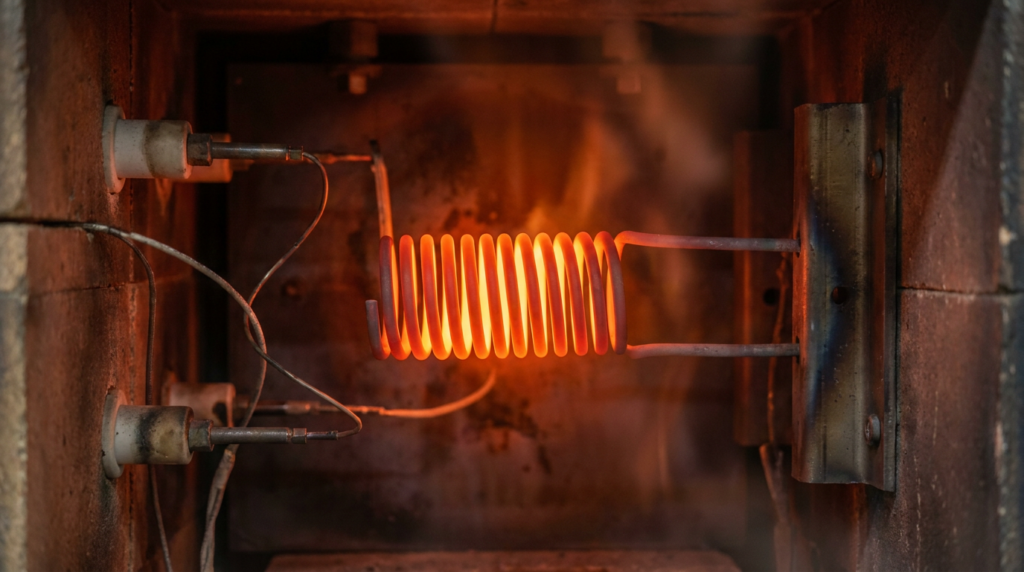
In the design of aerospace engines, fuel injection systems, and industrial gas turbines, springs are often the “heartbeat” of the mechanical system. However, when operating temperatures exceed 300°C (572°F), standard spring designs often suffer from an irreversible physical phenomenon: Stress Relaxation.
For Procurement Managers, relaxation means skyrocketing maintenance costs and unexpected downtime. For R&D Engineers, it means a total loss of system pressure and functional failure. This article provides a deep dive into the material science behind the two primary choices for custom high-temperature springs: Inconel X-750 and Stainless Steel (302/316 and 17-7PH).
1. The Physics of “Fatigue”: Why Springs Lose Tension
At ambient temperatures, a spring operates within its elastic deformation zone. As temperatures rise, atomic thermal agitation increases, allowing dislocations within the material crystal lattice to climb and glide more easily.
- Stress Relaxation: The decrease in force exerted by a spring over time while held at a constant strain.
- Creep: The permanent, time-dependent deformation of the spring under a constant load.
For most stainless steel alloys, the “tipping point” for these phenomena occurs between 250°C and 300°C.
2. Material Mechanics: The Head-to-Head Duel
A. Stainless Steel (302/316 & 17-7PH)
- Advantages: Highly cost-effective, excellent manufacturability, and superior corrosion resistance in low-to-mid temperature ranges.
- Limitations: While 17-7PH is a precipitation-hardened steel, its maximum reliable operating temperature is capped at 315°C (600°F). Beyond this, the strengthening precipitates (such as $Ni_3Al$) undergo coarsening, leading to a sharp drop in yield strength.
- Procurement Insight: Best suited for general industrial applications, consumer electronics, and mild heat environments.
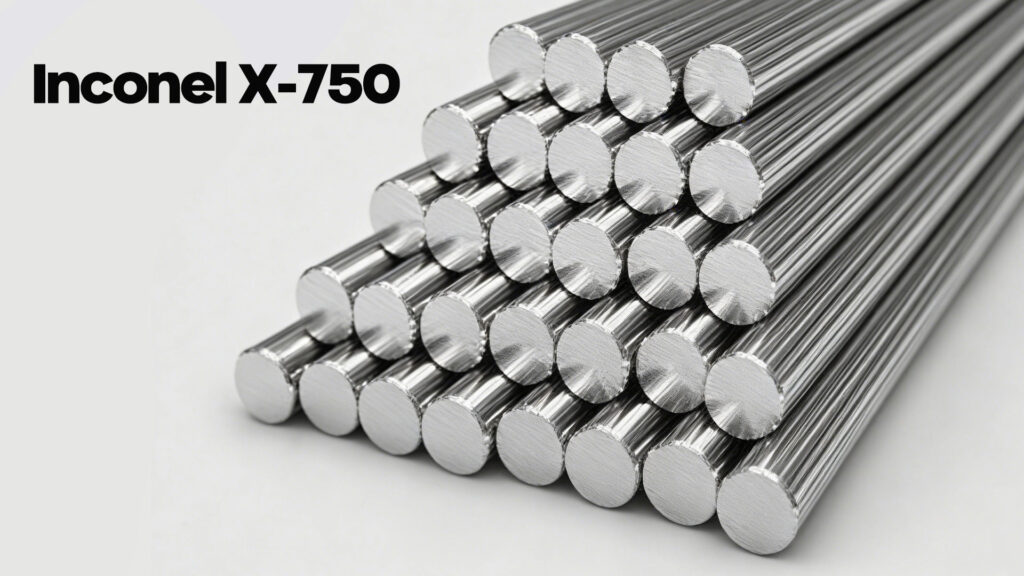
B. Inconel X-750 (Nickel-Base Precipitation-Hardenable Alloy)
- Advantages: A Nickel-Chromium alloy made hardy through additions of Aluminum, Titanium, and Niobium. It maintains exceptional oxidation resistance and mechanical strength up to 700°C (1292°F).
- The Competitive Edge: Between 500°C and 600°C, X-750 exhibits significantly lower relaxation rates than any stainless steel. The formation of the $\gamma’$ (Gamma prime) phase effectively pins dislocations, preventing the material from “softening.”
- Procurement Insight: Despite a higher initial unit cost, Inconel X-750 is the optimal choice for reducing Total Cost of Ownership (TCO) in “zero-fail” sectors like aerospace and nuclear power.
3. Data-Driven Comparison: Relaxation Rate Performance
Based on empirical data from Spring Materials and high-temp stress tests at 450°C (842°F) with an initial load of $400 MPa$:
| Material Type | Max Operating Temp | Load Loss after 1,000 Hours | Corrosion/Oxidation Resistance |
| SUS 302 | ~260°C | > 25% (Critical Failure) | Good |
| 17-7PH | ~315°C | ~15-20% | Excellent |
| Inconel X-750 | ~700°C | < 5% | Superior (High-Temp Oxidation) |
4. Engineering Recommendations for Custom Orders
When partnering with us for custom spring fabrication, we recommend the following selection logic:
- Identify Peak Transient Temperatures: If your system might hit 350°C even momentarily, bypass stainless steel and opt for Inconel.
- Heat Treatment Precision: The performance of Inconel X-750 is highly dependent on its thermal cycle (e.g., 1150°C Solutionizing + Precipitation Aging). We provide No.1 Temper or Solution Annealed states with secondary aging to ensure maximum creep resistance.
- Environmental Media: If the environment contains sulfides or strong acids at high heat, the chemical stability of Nickel alloys provides a vital safety margin.
Conclusion
In the world of high-end custom manufacturing, material choice dictates the ceiling of your product’s performance. As your specialized spring partner, we offer a robust Inconel supply chain and precision vacuum heat-treatment capabilities to ensure your springs maintain their “mechanical memory” in the harshest environments.
References & Sources
- SMI (Spring Manufacturers Institute): “Handbook of Spring Design“, 2023 Revision. (Standardized relaxation data for alloy materials).
- Special Metals Corporation: “Inconel Alloy X-750 Technical Bulletin”, Publication SMC-067. (Comprehensive chemical composition and high-temp tensile curves).
- ASTM A313/A313M: “Standard Specification for Stainless Steel Spring Wire”. (Mechanical properties for stainless spring grades).
- Journal of Materials Engineering and Performance: “Stress Relaxation Behavior of Nickel-Based Superalloys in High-Temperature Spring Applications”, Vol. 28, Issue 4.
- ISO 26910: “Springs — Shot peening”. (Technical standards for enhancing fatigue life in high-temp springs).
Are you facing spring failure in high-temperature applications?
We offer complimentary material simulation and rapid prototyping services. Contact our engineering team today for a technical consultation or a custom quote.