
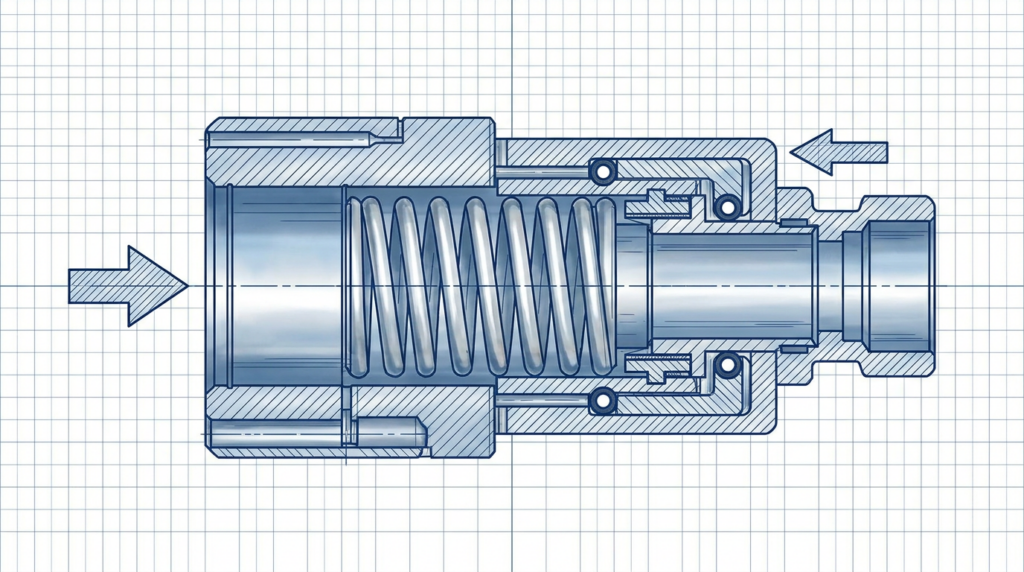
In high-performance fluid handling, medical devices, and electrical interconnects, the “click” of a successful connection is more than just a sound—it is the result of precise mechanical engineering. For design engineers, the primary challenge lies in balancing Insertion Force (IF) and Retention Force (RF).
While traditional locking mechanisms often struggle with consistency, the integration of Canted Coil Springs has revolutionized how we approach these force dynamics.
The Role of Canted Coil Springs in Force Management
The Canted Coil Spring is a specialized engineering component that provides a near-constant force over a wide range of deflection. Unlike standard compression springs, the individual coils are angled, allowing the spring to respond to axial or radial loads with a unique load-deflection curve.
1. Optimizing Insertion Force (IF)
Insertion force is the resistance an operator feels when mating the plug into the socket. In automated assembly lines or medical surgical tools, a high IF leads to fatigue and potential misalignment.
- Engineering Advantage: Canted coil springs allow for a “snap-top” feel with lower initial resistance compared to ball-lock mechanisms. Because the spring can be engineered with specific wire diameters and cant angles, we can precisely calibrate the peak insertion force.
2. Ensuring Reliable Retention Force (RF)
Retention force is the mechanical grip that prevents accidental disconnection.
- Engineering Advantage: The retention force is governed by the groove geometry (angles) and the spring’s radial load. By adjusting the lead-in and breakout angles of the mating grooves, engineers can achieve a specific ratio—for example, a system that is easy to plug in (low IF) but requires a significant, deliberate pull to disconnect (high RF).
Comparative Analysis: Canted Coil Spring vs. Traditional Mechanisms
For engineers choosing a locking element, the following table compares the Canted Coil Spring against common alternatives like Ball-Locks and Circlips (C-clips).
Technical Comparison Table
| Feature | Canted Coil Spring (Hengsheng) | Ball-Lock Mechanism | Standard Circlip / C-Clip |
| Force Consistency | Excellent (Flat load curve) | Moderate | Poor (High variance) |
| Space Requirement | Ultra-compact | Bulky (Requires sleeve) | Compact |
| Cycle Life | Very High (10,000+) | Moderate (Wear on balls) | Low (Permanent deformation) |
| Ergonomics | Smooth, tactile feedback | Harsh / Mechanical | Difficult to actuate |
| Electrical Conductivity | High (Multi-point contact) | Low/Intermittent | Poor |
| Customizability | Highly customizable angles | Limited to standard sizes | Limited |
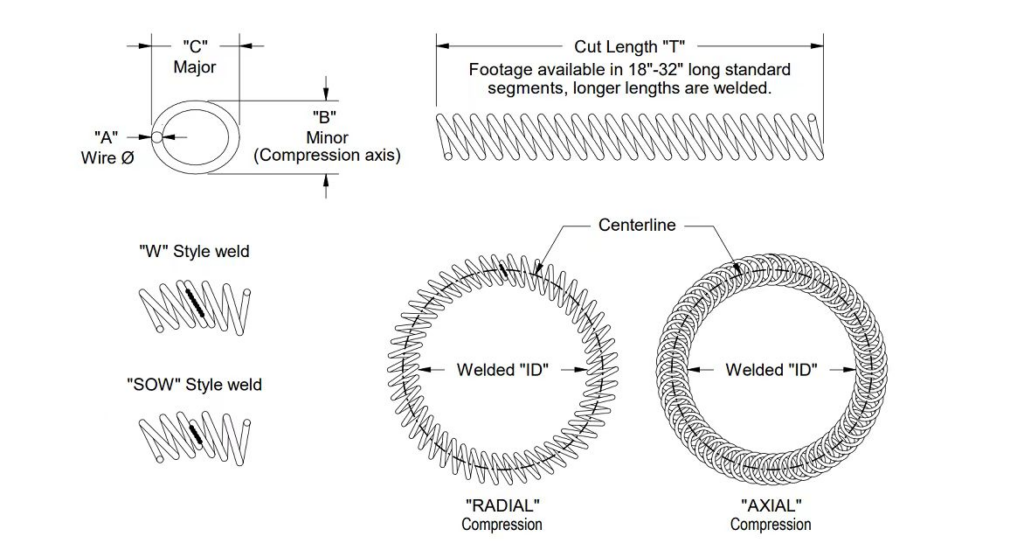
Engineering Calculations for Quick-Connect Design
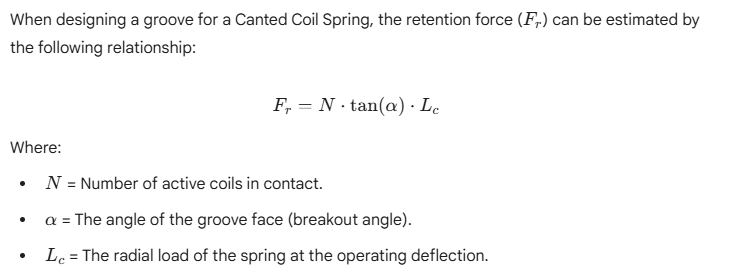
By manipulating the angle $\alpha$, Hengsheng engineers can create locking (permanent) or disconnectable (reusable) systems within the same space envelope.
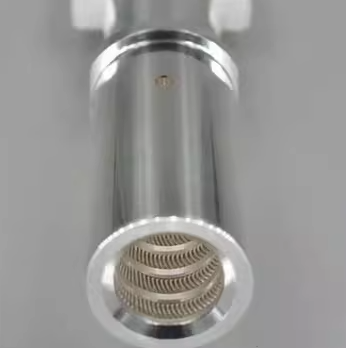
Why Materials Matter
At Hengsheng Spring, we understand that environmental factors dictate performance. We utilize advanced alloys to ensure force stability:
- Stainless Steel (302/316): For general corrosion resistance.
- Beryllium Copper (BeCu): For applications requiring high electrical conductivity and EMI shielding.
- Inconel / Hastelloy: For extreme chemical exposure or high-temperature aerospace environments.
Conclusion
Mastering the forces within a Quick-Connect system requires a shift from “brute force” components to “precision” components. The Canted Coil Spring offers a level of predictability and space-saving efficiency that traditional springs cannot match. Whether you are designing for a subsea connector or a handheld medical device, the spring’s geometry is the key to a superior user experience.
Technical References & Bibliography
- Journal of Mechanical Design (2022): “Non-linear Elasticity in Canted Coil Springs for Precision Locking Applications.”
- NASA Tech Briefs: “Innovative Solutions for Quick-Disconnect Fluid Couplings in Space Environments.”
- Spring Manufacturers Institute (SMI): Handbook of Spring Design, 10th Edition.
- ISO 19879: Metallic tube connections for fluid power and general use — Test methods for hydraulic fluid power connections.
This is an excellent article. Please keep it up; I will recommend it to my friends.