
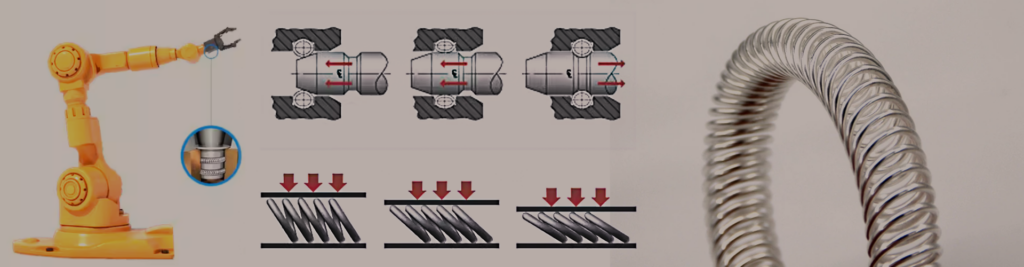
A Performance Comparison with Wave Springs and Helical Springs
1. How Engineers Typically Select Contact Springs
In electrical and electromechanical system design, engineers rarely prioritize novelty. Instead, selection criteria usually focus on:
- Stability of contact force over time
- Performance across wide compression ranges
- Resistance to vibration, thermal cycling, and tolerance variation
- Long-term reliability in Electrical Contact and EMI Shielding applications
For many years, helical compression springs and wave springs have been the most commonly used solutions due to their availability and familiarity. However, as systems demand higher reliability and tighter performance margins, these traditional spring types increasingly reveal fundamental mechanical limitations.
This has led many engineers to re-evaluate the Canted Coil Spring as a purpose-engineered solution rather than an alternative.
2. The Critical Metric: Force–Deflection Stability
2.1 Why Constant Contact Force Matters
In applications involving electrical conduction or EMI Shielding, performance is governed not by maximum load capacity, but by how consistently force is maintained across displacement.
Unstable contact force can result in:
- Increasing contact resistance
- Signal noise or intermittent conduction
- Fretting corrosion caused by micro-motion
- Degradation of EMI shielding effectiveness
An ideal spring for these applications must therefore provide near-constant load over a broad compression range.
3. Mechanical Performance Comparison
3.1 Force–Deflection Characteristics
| Spring Type | Load Behavior | Effective Compression Range | Suitability for Electrical Contact |
|---|---|---|---|
| Helical Compression Spring | Linear force increase | Narrow to moderate | Limited |
| Wave Spring | Progressive force increase | Moderate | Moderate |
| Canted Coil Spring | Near-constant force | Wide | Excellent |
3.2 Helical Compression Springs
Helical springs follow Hooke’s Law: force increases linearly with deflection. While this behavior is predictable, it presents several drawbacks for contact-sensitive systems:
- Small dimensional changes lead to large force variation
- High sensitivity to tolerance stack-up and thermal expansion
- Risk of overloading contacts or losing preload over time
As a result, helical springs are often unsuitable for precision Electrical Contact interfaces.
3.3 Wave Springs
Wave springs reduce solid height and can provide moderate force in constrained spaces. However:
- Their load still increases with compression
- Force stability degrades under vibration and thermal cycling
- Contact pressure is not evenly distributed
Wave springs are frequently selected for packaging efficiency rather than for maintaining stable contact force.
3.4 Canted Coil Springs
Canted Coil Springs differ fundamentally in geometry and behavior:
- Coils are arranged at a fixed inclination angle
- Each coil deflects independently
- Load is distributed across multiple contact points
This structure produces a flat force–deflection curve, allowing the spring to maintain nearly constant contact force over a wide compression range—something neither wave nor helical springs can achieve.
4. The Mechanical Principle Behind Constant Load
The unique geometry of a Canted Coil Spring enables:
- Angular deformation rather than axial stacking
- Reduced stress concentration within the wire
- High elastic recovery and repeatability
Because force does not rise sharply with compression, the spring naturally compensates for:
- Manufacturing tolerances
- Thermal expansion and contraction
- Long-term material relaxation
This makes Canted Coil Springs especially well suited for long-life applications requiring consistent performance.
5. Advantages in Electrical Contact Applications
In Electrical Contact systems, Canted Coil Springs provide several measurable benefits:
- Stable and low contact resistance over time
- Reduced susceptibility to vibration-induced micro-motion
- Improved durability under repeated mating cycles
Typical applications include:
- High-reliability connectors
- Power distribution interfaces
- Battery pack interconnects
In these environments, force consistency directly translates into electrical stability.
6. EMI Shielding Performance and Compliance
Effective EMI Shielding requires uniform and continuous conductive contact along seams, interfaces, and enclosure joints.
Canted Coil Springs excel in this role by:
- Maintaining consistent pressure despite gap variation
- Providing continuous conductive paths
- Combining mechanical compliance and electrical grounding in a single element
In contrast, wave and helical springs often create localized high-pressure points, which can lead to shielding discontinuities and reduced EMC performance.
7. Case Studies from High-Reliability Industries
7.1 Power Distribution Equipment
In electrical power distribution systems, Canted Coil Springs are used in contact interfaces exposed to temperature variation and vibration. Field data from industrial installations show improved stability of contact resistance compared to rigid or traditional spring-loaded solutions, contributing to increased operational reliability.
7.2 Aerospace and Satellite Systems
Satellite and aerospace platforms rely on compliant spring contacts for both electrical continuity and EMI Shielding. Canted Coil Springs are commonly applied in connector and enclosure interfaces where maintenance is impossible and performance must remain stable across extreme thermal environments.
These industries establish reliability benchmarks that increasingly influence automotive and EV system design.
8. Reconsidering Traditional Spring Choices
As modern systems become:
- More compact
- More electrically sensitive
- More reliability-driven
The question is no longer whether a wave or helical spring can be used, but whether it can guarantee stable performance over the entire service life.
For demanding Electrical Contact and EMI Shielding applications, Canted Coil Springs offer a mechanically superior solution.
9. A Structural Advantage with System-Level Impact
The advantages of Canted Coil Springs are grounded in physics
By delivering:
- Near-constant contact force
- Wide compression tolerance
- Superior electrical and shielding performance
Canted Coil Springs function as system-enabling components, rather than simple mechanical parts.
For engineers designing high-reliability systems, they represent not just an alternative—but a best-in-class choice.