
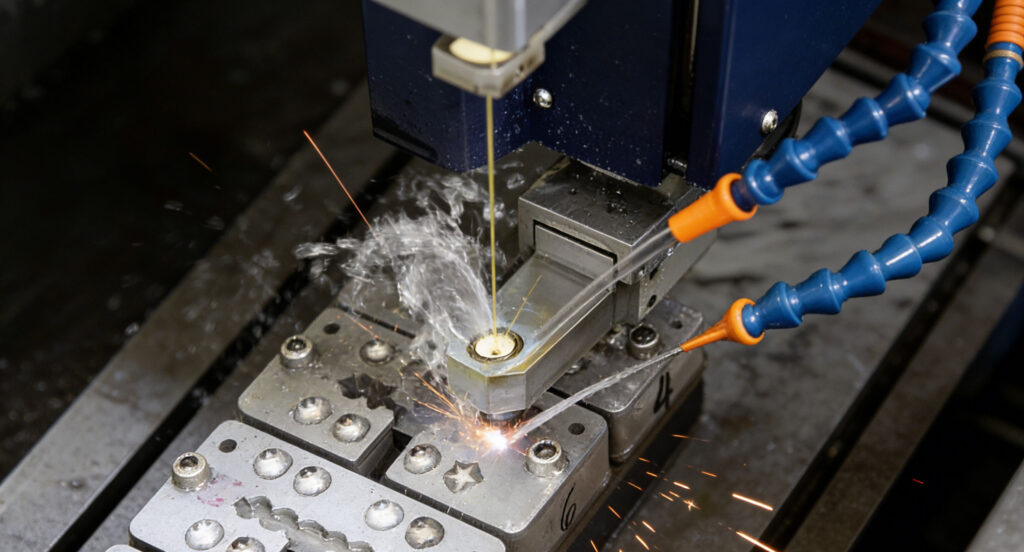
Wire EDM—short for Wire Electrical Discharge Machining—is a thermal cutting process that uses a continuously moving, electrically charged wire to remove material through controlled spark erosion. Unlike conventional machining, Wire EDM does not rely on mechanical force; instead, it melts and vaporizes material with extremely high-frequency electrical discharges. This makes it ideal for creating highly precise, complex shapes in hard-to-machine metals.
1. How Wire EDM Works
Wire EDM operates based on three core principles:
1.1 Electrical Spark Erosion
A brass, copper, or coated wire serves as the electrode. When voltage is applied, millions of tiny sparks occur between the wire and workpiece, removing material in microscopic amounts.
1.2 Deionized Water as Dielectric Fluid
The cutting area is submerged in deionized water, which:
cools the workpiece,
flushes away debris,
stabilizes the spark channel,
prevents short-circuiting.
1.3 Continuous Wire Feeding
The wire is constantly renewed during cutting, ensuring stable discharge and consistent accuracy.
2. Advantages of Wire EDM
Wire EDM offers unique capabilities that conventional CNC machining cannot match.
2.1 Ultra-High Accuracy
Wire EDM can achieve:
±2–5 μm tolerance
Ra 0.1–0.4 μm surface finish
This makes it suitable for precision toolmaking, dies, and complex profiles.
2.2 Cuts Extremely Hard Materials
Hardness does not affect machinability. EDM can cut materials such as:
Tool steel (HRC 60+)
Tungsten carbide
Titanium alloys
Inconel & Hastelloy
Copper & brass
Hardened stainless steel
2.3 No Mechanical Stress
Since there is no cutting force, Wire EDM avoids:
deformation,
residual stress,
burr formation.
2.4 Complex Geometry Capability
Wire EDM excels at:
sharp internal corners,
intricate contours,
narrow slots,
thin walls,
fine details impossible by milling or turning.
3. Limitations of Wire EDM
While powerful, Wire EDM has constraints engineers should consider.
3.1 Conductive Materials Only
Non-conductive materials (plastic, ceramic) are not suitable.
3.2 Slower Than Laser or CNC Machining
Wire EDM is precise but time-consuming, especially for thick or complex parts.
3.3 Heat-Affected Recast Layer
Although minimal, a microscopic recast layer may remain and must be removed for critical components.
4. Key Applications of Wire EDM
Wire EDM is widely used in industries where precision is critical.
4.1 Tool & Mold Making
Punches and dies
Injection mold inserts
Extrusion dies
Progressive stamping dies
4.2 Aerospace
turbine blades
fuel system components
nickel-based alloys machining
4.3 Automotive
transmission components
precision gears
fuel injector parts
4.4 Medical Devices
surgical instruments
orthopedic implants
micro components
4.5 Electronics
precision connectors
micro gears
semiconductor tooling
5. Wire EDM Design Guidelines
For better manufacturability and performance:
5.1 Minimum Corner Radius
Wire diameter defines corner radius.
Typical wire diameter: 0.10–0.30 mm
Minimum achievable radius ≈ wire radius + spark gap
Example: 0.25 mm wire → ~0.15 mm internal corner radius.
5.2 Minimum Slot Width
Slot width should be ≥ wire diameter + 20–30 μm for stability.
5.3 Avoid Full-Depth Sharp Corners
Use small relief pockets if possible to reduce cutting time and stress concentration.
5.4 Part Height
Optimal height range: 10–300 mm
Taller parts require slower and more careful cutting.
5.5 Heat-Treated Materials
For best results:
Heat-treat material first
Wire-cut afterwards
This ensures minimal deformation.
6. Wire EDM Cutting Variants
6.1 Rough Cut vs. Trim Cuts
Rough Cut: fast, leaves thicker recast layer
Trim Cuts (2–7 passes): refining accuracy & finish
6.2 Taper Cutting
Advanced machines allow up to 45° taper, depending on thickness.
6.3 Multi-Axis Wire EDM
Used for:
complex tapers
conical shapes
injection mold parting lines
7. Compared With Other Cutting Processes
| Process | Accuracy | Hard Materials | Heat Affected Zone | Complexity | Speed |
|---|---|---|---|---|---|
| Wire EDM | ★★★★★ | ★★★★★ | Very small | Excellent | Slow |
| CNC Milling | ★★★★☆ | ★★☆☆☆ | None | Good | Medium |
| Laser Cutting | ★★☆☆☆ | ★★★★☆ | High | Fair | Fast |
| Waterjet | ★★★☆☆ | ★★★★★ | None | Good | Medium |
Wire EDM is the precision king, ideal for high-accuracy tasks.
8. Why Choose Our Factory for Wire EDM Services?
As a professional manufacturing factory in China, we possess:
20+ years machining & tooling experience
advanced Wire EDM machines from Japan & Switzerland
in-house CNC machining, stamping, surface treatment, and QC
±3 μm precision control capability
full support from prototype to mass production
competitive global pricing with stable delivery
We deliver tight-tolerance components for customers in automotive, medical, aerospace, robotics, and industrial machinery.